
Quick Answer
There is no tablet that permanently cures a tooth infection. Painkillers like paracetamol or ibuprofen manage the pain, and antibiotics prescribed by a dentist can control an infection that is spreading, but the infection always returns until its source, the dead or infected tissue inside the tooth, is removed by a root canal or extraction. Buying antibiotics from a pharmacy without seeing a dentist is the most common and most costly mistake in Pakistan: it delays real treatment, breeds resistance, and lets a fixable tooth become an unfixable one. Swelling of the face, fever, or difficulty swallowing means emergency care today, not another tablet.
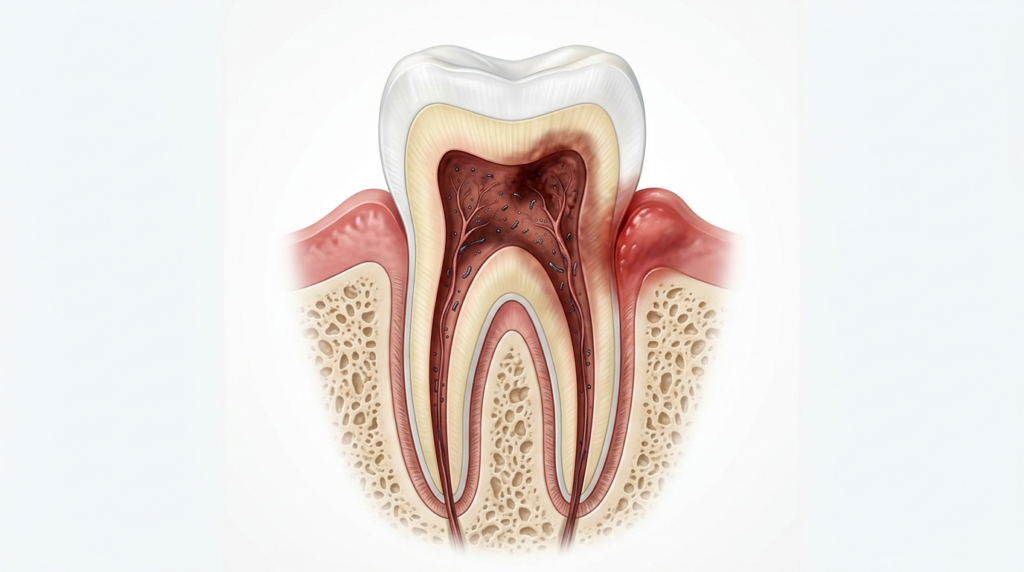
The question arrives at every pharmacy counter in Pakistan daily: “dant ke infection ki best medicine kaun si hai?” It deserves a straight answer, and the straight answer is uncomfortable: the question itself is the trap. A tooth infection is not like a throat infection that your immune system, helped by a course of antibiotics, clears completely. When decay or a crack lets bacteria reach the pulp, the nerve and blood vessels inside the tooth, that tissue dies. Dead tissue has no blood supply, and no blood supply means no antibiotic can reach the bacteria camped inside the tooth. The drug circulates in your blood; the bacteria sit in a sealed chamber your blood no longer enters.
This is why the familiar cycle happens to so many people: a course of antibiotics from the pharmacy, relief within days, and the same swelling back within weeks or months, usually worse. The medicine suppressed the infection’s spread into surrounding tissue; it never touched the factory producing the bacteria. Each repeat of this cycle makes bacteria more resistant and the tooth harder to save. Meanwhile the actual fix, root canal treatment to clean out the dead tissue, or extraction when the tooth is beyond saving, ends the problem permanently. This guide lays out what each medicine genuinely does, when antibiotics are the right call, and the red flags that turn a dental problem into a medical emergency.
What Each Medicine Actually Does
Medicine | What it does | What it cannot do |
Paracetamol | Reduces pain safely for most people | Nothing against the infection itself |
Ibuprofen and similar (NSAIDs) | Reduces pain and inflammation; often works best for dental pain | Does not treat the infection source |
Antibiotics (dentist-prescribed) | Control infection spreading into gums, jaw or face | Cannot reach bacteria inside a dead tooth; infection returns |
Antiseptic rinses, clove oil | Minor surface comfort | No effect on infection inside the tooth |
Root canal or extraction | Removes the source; the only permanent cure | Requires a dental visit, which is the point |
Painkillers are legitimate as a bridge to the appointment; take them according to the packet or your doctor’s advice, never more, and never let controlled pain convince you the problem is gone. Pain relief is not cure; the bacteria do not read the packet.
When Antibiotics Are Genuinely Needed, and When They Are Not
Dentists prescribe antibiotics for a tooth infection when it is spreading beyond the tooth: visible swelling in the gum or face, fever, swollen lymph nodes, or when a patient’s health condition makes infection riskier. Commonly prescribed options in Pakistan include amoxicillin, amoxicillin with clavulanic acid, metronidazole added in some cases, and alternatives for penicillin-allergic patients; which one, at what dose, for how long, is precisely the decision that needs a dentist looking at your mouth, because the wrong drug treats nothing and the half-finished course trains the bacteria.
Equally important is the reverse: a localized toothache without swelling or fever usually does not need antibiotics at all. It needs the tooth treated. International dental guidelines have moved firmly in this direction because decades of reflexive antibiotic use created resistant infections, and Pakistan, where antibiotics sell over the counter, sits near the top of global resistance rankings. Every unnecessary course you take makes the antibiotic weaker for the day you or your family genuinely need it.
The Red Flags That Mean Today, Not Next Week

Sign | Why it is urgent |
Swelling of the cheek, jaw or under the eye | Infection spreading through facial spaces |
Fever with a toothache | Body-level response; infection is no longer local |
Difficulty opening the mouth, swallowing or breathing | Can threaten the airway; hospital-level emergency |
Swelling spreading toward the eye or neck | Dangerous directions; do not wait |
Feeling generally ill, weak or confused | Possible systemic spread |
Any of these deserves an emergency dental visit the same day, and difficulty breathing or swallowing means the nearest hospital emergency, immediately. A dental abscess is a pocket of pus, and pus under pressure looks for exits; the dentist’s drainage plus targeted treatment settles in a day what tablets cannot settle in a month.
What Actually Ends the Infection
The permanent fix is mechanical, not chemical: remove the infected material. A root canal cleans the dead pulp out of the tooth’s internal chambers, disinfects them and seals them, keeping the tooth in your mouth for years or decades. Extraction removes the tooth entirely when it is too broken down to restore. Which one applies depends on how much sound tooth remains, which only an examination and usually an X-ray can tell. If cost is the worry pushing you toward the pharmacy instead, know the honest arithmetic: repeated antibiotic courses, painkillers, and lost workdays over months routinely cost more than the root canal that would have ended it, and they often end in the extraction anyway, with a gap that then costs far more to fill. If a tooth has been hurting or a gum boil keeps appearing and disappearing, book an examination and bring the list of medicines already tried; it genuinely speeds up the diagnosis, a pattern we also explained in our guide on choosing the right solution for tooth pain.
Frequently Asked Questions
What is the best medicine for a tooth infection?
There is no medicine that cures it. Painkillers manage the pain and dentist-prescribed antibiotics control spreading infection, but the cure is removing the source through root canal treatment or extraction. Any tablet-only approach gives temporary relief and a returning infection.
Can antibiotics alone cure a tooth infection?
No. The infected tissue inside the tooth has no blood supply, so antibiotics cannot reach the bacteria there. Antibiotics protect the surrounding tissues while definitive treatment is arranged; skipping that treatment guarantees the infection returns.
Which antibiotic do dentists prescribe for tooth infection?
Commonly amoxicillin, amoxicillin-clavulanate, sometimes with metronidazole, or alternatives for penicillin-allergic patients. The choice, dose and duration depend on the examination, which is why buying them yourself from a pharmacy is both ineffective long-term and a driver of antibiotic resistance.
How do I know if a tooth infection is spreading?
Swelling of the face or jaw, fever, swollen glands, difficulty opening the mouth or swallowing, and feeling generally unwell are spreading signs. These need same-day dental or hospital care, not a stronger tablet.
Will a tooth infection go away on its own?
No. It may go quiet when pus finds a drainage path, often through a small gum boil, but the source remains and it flares again, typically worse. Silence between flare-ups is the infection waiting, not healing.
