
Quick Answer
A full adult set is 32 teeth: 8 incisors, 4 canines, 8 premolars and 12 molars, including the 4 wisdom teeth. Because wisdom teeth are so often removed or never develop, most adults in Pakistan live with 28 teeth, and that is completely normal. Children have 20 primary (milk) teeth: 8 incisors, 4 canines and 8 molars, with no premolars and no wisdom teeth. The first baby tooth usually appears around 6 months, the last baby tooth falls out around 12, and the wisdom teeth, if they come at all, arrive between 17 and 25.
Count your own teeth in a mirror and there is a fair chance the number is not 32, and there is nothing wrong with you. The textbook figure of 32 describes the complete blueprint the body carries; the number actually standing in an adult mouth depends on whether the wisdom teeth erupted, whether they were extracted, whether any teeth were lost to decay or gum disease, and occasionally whether a tooth simply never formed. That gap between the blueprint and the reality is why a simple-sounding question produces so many different answers at the family dinner table, and why it deserves a clear explanation rather than a single number.
The count matters for more than curiosity. Knowing how many teeth a child should have at a given age is how parents catch a tooth that is late or missing; knowing that an adult set is 28 working teeth plus 4 optional ones settles the anxiety when a dentist recommends wisdom tooth removal; and knowing which teeth do which job explains why losing a single back molar changes chewing more than losing a front tooth changes it. This guide gives the full count for children and adults, the timeline on which the two sets arrive and depart, and the honest reasons your mouth may hold fewer, or in rare cases more, than the standard number.
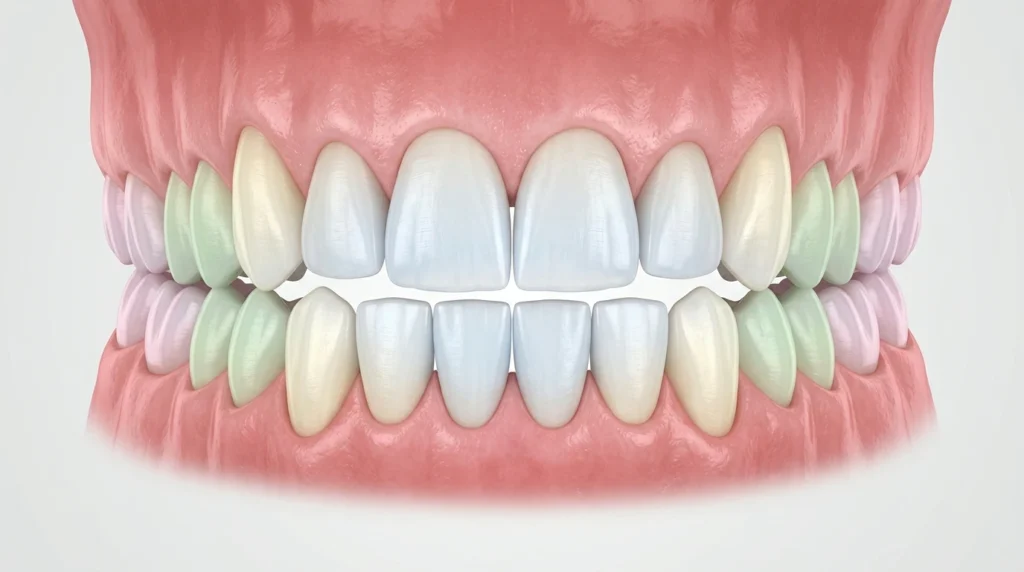
The Adult Count: 32 Teeth by Type
| Tooth type | How many | Where | Job |
| Incisors | 8 (4 upper, 4 lower) | Front and centre | Cutting and biting into food |
| Canines | 4 (2 upper, 2 lower) | The pointed corners | Tearing; guide the bite when jaws close |
| Premolars | 8 (4 upper, 4 lower) | Between canines and molars | Crushing and beginning to grind |
| Molars | 12 (6 upper, 6 lower) | Back of the mouth | Heavy grinding; includes 4 wisdom teeth |
| Total | 32 | 16 per jaw | 28 without wisdom teeth |
Each jaw mirrors the other and each side mirrors its opposite, so every adult tooth exists as a set of four: four first molars, four canines, and so on. The exception in practice is the third molar, the wisdom tooth, which is the last to arrive, the most likely to be missing, and the least missed when gone.
The Child Count: 20 Primary Teeth
| Tooth type | How many | Note |
| Incisors | 8 (4 upper, 4 lower) | First to appear, usually the lower central pair |
| Canines | 4 (2 upper, 2 lower) | Arrive around 16 to 22 months |
| Molars | 8 (4 upper, 4 lower) | Two per side per jaw; no premolars in the primary set |
| Total | 20 | 10 per jaw, complete by about 2½ to 3 years |
Primary teeth are smaller and whiter than permanent teeth and their enamel is thinner, which is why a cavity in a milk tooth reaches the nerve so much faster. They are not disposable: each one holds space for the permanent tooth growing beneath it, and losing a milk tooth early to decay lets the neighbours drift into the gap, a leading cause of crowding later. If you want the month-by-month order, our baby teeth chart lays out every tooth’s arrival and departure.
The Timeline: From 0 to 32
| Age | What happens | Teeth in the mouth |
| Birth | No visible teeth; all 20 primary crowns already forming in the jaw | 0 |
| About 6 months (range 4 to 12) | First lower incisors erupt | 1 to 2 |
| 2½ to 3 years | Full primary set complete | 20 |
| About 6 years | First permanent molars erupt behind the milk molars; lower front milk teeth fall out | Up to 24 (mixed) |
| 6 to 12 years | Milk teeth fall out one by one and permanent teeth replace them; premolars appear | 20 to 28 (mixed) |
| 12 to 13 years | Second permanent molars erupt; last milk tooth gone | 28 |
| 17 to 25 years | Wisdom teeth erupt, partly erupt, stay buried, or never form | 28 to 32 |
Two points on this timeline surprise most parents. First, a six-year-old can hold 24 teeth at once, because the four first permanent molars come in behind the milk teeth without replacing anything; parents often mistake these for milk teeth and let decay set in, not realizing they are the permanent molars the child will chew on for life. Second, the “6 months” for a first tooth is an average with a wide range; a baby with no teeth at 10 or 11 months is usually just late, and a checkup rather than worry is the right response only if the first birthday passes with an empty gum.

Why Your Count May Not Be 32
The most common reason is wisdom teeth. They are the last teeth to form and modern jaws frequently have no room for them, so they stay buried, come through sideways, or are removed; a meaningful share of people never develop one or more of them at all. A mouth with 28 teeth is a complete, fully functional adult mouth, which is why a recommendation to remove troublesome wisdom teeth costs nothing in chewing ability. The second reason is loss: decay, gum disease and injury remove teeth that should have stayed, and in Pakistan gum disease and untreated cavities together account for most missing molars in adults over 40. Every tooth lost from the working set of 28 matters, because the neighbours tilt and the opposing tooth over-erupts into the gap, which is why a lost molar deserves a replacement plan rather than a shrug. The third reason is congenital: some people are born missing a tooth, most often a wisdom tooth, an upper lateral incisor or a second premolar, and a small number develop an extra tooth. Neither is a health problem in itself; both are worth knowing about, because a missing permanent tooth can leave a milk tooth in place for decades, and an extra tooth can block a normal one from erupting.
What the Count Tells You to Watch For
For a child: a milk tooth that has not arrived by the first birthday, a permanent tooth visible behind a milk tooth that refuses to loosen, or a gap that has stayed empty for more than 6 months after a milk tooth fell out each deserve a dentist’s look, usually with a single X-ray that shows exactly what is waiting underneath. For an adult: any tooth you can no longer account for, a wisdom tooth that is half-erupted with a flap of gum over it, or a jaw that aches at the back in the late teens or twenties are the signals to book an examination. Half-erupted wisdom teeth trap food under the gum flap and are the usual cause of the swelling and pain we described in our guide on the wisdom tooth pain timeline; a mouth that stays at 28 because those teeth were removed cleanly is healthier than one at 30 with two half-buried molars.
Frequently Asked Questions
How many teeth do adults have without wisdom teeth?
- The adult set is 32 including the 4 wisdom teeth, so removing all four, or never developing them, leaves 28 teeth: 8 incisors, 4 canines, 8 premolars and 8 molars. This is a complete, fully functional adult mouth.
How many teeth does a child have?
20 primary or milk teeth: 8 incisors, 4 canines and 8 molars, 10 in each jaw. The set is usually complete by about 2½ to 3 years. Children have no premolars and no wisdom teeth; those appear only in the permanent set.
At what age do children have all 32 teeth?
Most people have 28 permanent teeth by 12 to 13 years. The final 4, the wisdom teeth, erupt between 17 and 25 if they erupt at all, so a full 32 is typically reached in the early twenties, and many people never reach it because wisdom teeth stay buried or are removed.
Is it normal to have only 28 teeth?
Yes. Wisdom teeth are the most commonly missing or extracted teeth, and living with 28 is the norm for many adults. It becomes worth checking only if teeth other than the wisdom teeth are missing, since those gaps affect chewing and let neighbouring teeth drift.
Can a person have more than 32 teeth?
Occasionally. Extra teeth, called supernumerary teeth, form in a small number of people, most often a small extra tooth between the upper front incisors or behind the molars. They are usually harmless but can block a normal tooth from erupting, so a dentist typically checks with an X-ray and removes them if they are in the way.
