

A tooth cavity is one of the most common dental problems people experience at every age, from young children to older adults. It develops when the hard outer layer of a tooth, called enamel, is slowly worn away by acids produced by bacteria living in the mouth. Left untreated, a small cavity can grow deeper into the tooth and eventually require a dental filling, a crown, or in more advanced cases a root canal. The good news is that a cavity is almost always preventable, and when caught early it is simple to treat. In this guide we will walk through exactly what causes a cavity, the early signs to watch for, how dentists diagnose and treat decay, and the daily habits that keep your teeth cavity free for years to come. Whether you are dealing with sudden tooth pain or you simply want to understand your oral health better, this article covers everything you need to know about tooth decay in plain, practical language.
What Causes a Tooth Cavity
A cavity forms through a slow, ongoing process rather than happening overnight. Every mouth naturally carries bacteria, and some of these bacteria feed on the sugars and starches left behind after eating. As they break down these food particles, the bacteria release acid as a byproduct. This acid attacks the mineral structure of the enamel, gradually softening and dissolving it in a process dentists call demineralization. Over time, repeated acid attacks create a small hole, which is what we know as a cavity.
Several factors make this process happen faster. Frequent snacking, especially on sugary or starchy foods, gives bacteria a constant fuel supply. Sipping sugary drinks throughout the day, including soft drinks, sweetened tea, and even fruit juice, bathes the teeth in acid for extended periods. Poor brushing habits allow plaque, a sticky film of bacteria, to build up along the gum line and between teeth where a toothbrush often misses. A dry mouth also raises the risk significantly, since saliva plays a natural protective role by washing away food particles and neutralizing acid. People who breathe through their mouth, take certain medications, or have reduced saliva flow tend to develop cavities more easily. Genetics and the natural strength of a person’s enamel can play a role too, which is why some people seem more cavity prone than others despite similar habits.
Early Signs and Symptoms of a Cavity
One of the trickiest things about tooth decay is that it often causes no noticeable symptoms in its earliest stage. As the cavity progresses, however, several warning signs tend to appear. A chalky white spot on the tooth surface is usually the first visible clue, marking the point where minerals have started leaching out of the enamel. As decay advances, this spot may darken into a brown or black stain, and a visible pit or hole can sometimes be seen or felt with the tongue.
Sensitivity is another common early symptom. Many people notice a sharp twinge when eating something hot, cold, sweet, or acidic, which happens once the decay reaches the inner layer of the tooth called dentin. As the cavity deepens further, pain can become more persistent, especially when biting down, and in advanced cases a dull ache may linger even without eating. A lingering bad taste or mild bad breath localized to one tooth can also point to decay. Because these symptoms often develop gradually, many people do not realize they have a cavity until a dentist spots it during a routine checkup or an x ray.
The Stages of Tooth Decay
Understanding how a cavity progresses helps explain why early treatment matters so much. In the first stage, called demineralization, the enamel begins losing minerals but the surface remains intact, often appearing as a white spot. At this point the process can sometimes be reversed with fluoride treatment and improved oral hygiene, without any drilling needed.
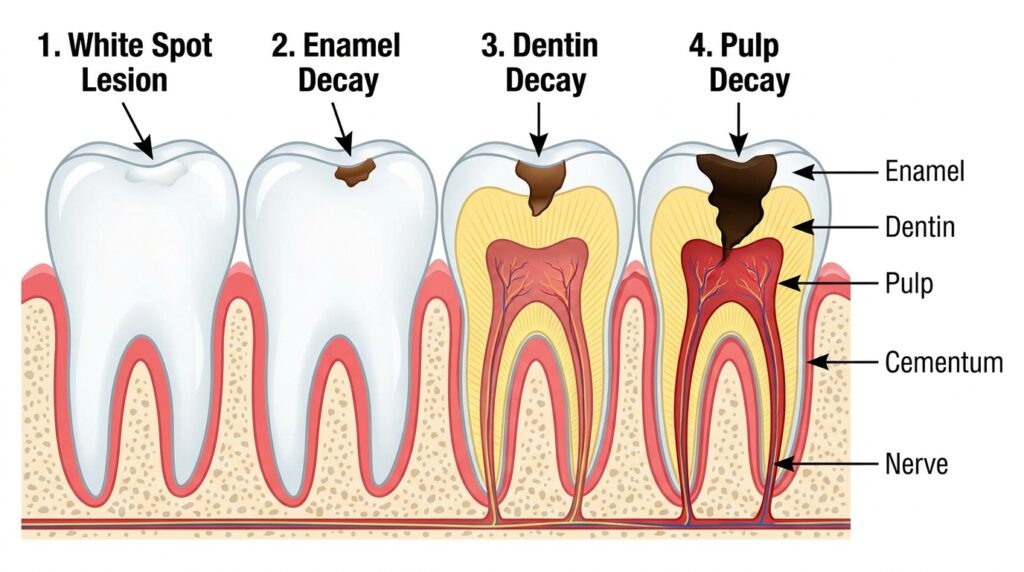
In the second stage, the enamel itself breaks down and an actual cavity begins to form. Once decay reaches this point it cannot heal on its own and needs a filling to stop it from spreading further. The third stage involves the dentin, the softer layer beneath the enamel, where decay moves faster and sensitivity becomes more noticeable. If decay is allowed to continue into the fourth stage, it reaches the pulp, the innermost part of the tooth containing nerves and blood vessels, which typically causes significant pain and often requires root canal treatment to save the tooth. In the final stage, untreated decay can lead to a dental abscess, a painful infection at the root of the tooth that may cause swelling, fever, and, in severe cases, can spread to surrounding tissue if not treated promptly.
How Dentists Diagnose a Cavity
A dental exam typically starts with a visual inspection, where the dentist looks for discoloration, visible holes, or soft spots on the tooth surface. A small metal instrument may be used to gently probe suspicious areas, feeling for the stickiness that indicates decay has softened the enamel. Since many cavities form between teeth or below the gum line where they cannot be seen directly, dental x rays are an essential diagnostic tool, allowing the dentist to spot decay hiding beneath the surface long before it becomes visible or painful. Some modern clinics also use laser fluorescence devices that can detect very early decay that might otherwise be missed.
Regular professional teeth cleaning and checkup visits every six months give your dentist the best chance of catching a cavity while it is still small and easy to treat.
Treatment Options for a Cavity
The right treatment depends on how far the decay has progressed. For small to moderate cavities, a filling is usually the standard solution. During this procedure the dentist removes the decayed portion of the tooth and fills the space with a material such as composite resin, which matches the natural tooth color, or in some cases a more traditional amalgam material. Fillings are quick, generally comfortable with local anesthesia, and can last many years with proper care.
When a cavity is larger and too much of the tooth structure has been lost to support a simple filling, a dental crown may be recommended instead. A crown covers the entire visible portion of the tooth, restoring its strength, shape, and function. If decay has reached the pulp and caused infection or severe pain, root canal treatment becomes necessary. This procedure removes the infected tissue from inside the tooth, cleans the canal, and seals it to prevent further infection, allowing the natural tooth to be saved rather than extracted. In rare cases where a tooth is too badly damaged to repair, extraction may be the only remaining option, followed by a replacement solution such as an implant or bridge if needed.
Every case is different, and the safest way to know which treatment applies to your situation is a proper examination. You can explore our dental services to see the full range of options available for treating cavities and other tooth decay related concerns.
How to Prevent Cavities
Prevention remains far easier and less expensive than treatment, and most cavities are avoidable with consistent daily habits. Brushing twice a day with a fluoride toothpaste is the foundation of cavity prevention, since fluoride helps strengthen enamel and makes it more resistant to acid attacks. Flossing once a day removes food particles and plaque from between the teeth, an area a toothbrush cannot reach effectively.

Diet also plays a major role. Limiting how often you snack on sugary or starchy foods reduces the number of acid attacks your teeth face each day, and rinsing your mouth with water after eating can help wash away leftover food particles. Chewing sugar free gum after meals stimulates saliva flow, which naturally helps neutralize acid and remineralize weakened enamel. For children, dental sealants applied to the chewing surfaces of back teeth act as a protective barrier against decay in the deep grooves where cavities commonly start. Finally, keeping up with regular dental visits allows your dentist to apply professional fluoride treatments, monitor your risk factors, and catch any early signs of decay before they turn into a bigger problem.
Cavities Between Teeth Compared to Cavities on Chewing Surfaces
Not all cavities behave the same way, and where a cavity forms can affect both how quickly it is noticed and how it needs to be treated. Cavities that form on the chewing surfaces of back teeth, in the natural pits and grooves, are usually the easiest to spot during a routine exam because they are visible and often show clear discoloration. These are also the areas dental sealants are designed to protect, since food and bacteria collect easily in these deep grooves.
Cavities that form between teeth are far less obvious. They often go unnoticed for a long time because you cannot see or feel them directly, and floss is really the only home tool that reaches this space effectively. This is one reason dentists rely heavily on x rays, since a cavity between two teeth can grow quite large before it ever becomes visible or painful. Cavities near the gum line present their own challenge too, since they are close to the root surface, which has a thinner, softer structure than the crown of the tooth and can decay more quickly once exposed, often due to gum recession or aggressive brushing that has worn away protective tissue over time.
The Link Between Diet and Cavity Risk
While brushing and flossing are essential, what and how often you eat plays an equally important role in cavity prevention. It is not just the amount of sugar in your diet that matters but how frequently your teeth are exposed to it. Sipping a sweetened drink slowly over an hour actually exposes your teeth to acid for far longer than drinking the same beverage quickly with a meal, since saliva needs time between exposures to neutralize acid and restore a normal pH in the mouth. Sticky foods such as dried fruit or certain candies cling to the tooth surface long after eating, giving bacteria extended access to fuel. On the other hand, foods high in calcium and phosphate, such as cheese and plain yogurt, can actually help support remineralization of the enamel. Being mindful of not just what you eat but when and how often can meaningfully lower your overall cavity risk, even without dramatic changes to your diet.
When to See a Dentist
Do not wait for pain before scheduling a visit, since many cavities develop silently in their early stages. You should see a dentist promptly if you notice visible dark spots or holes on a tooth, sensitivity that lingers after eating something hot or cold, pain when chewing, or any swelling around a tooth or gum. Even without symptoms, a checkup every six months remains the best way to catch decay early, when treatment is simplest and least expensive. If it has been a while since your last visit, consider using this guide as a reminder to book a checkup and get ahead of any potential problems before they grow.
Frequently Asked Questions
Can a cavity heal on its own without a dentist?
Very early demineralization, seen as a white spot, can sometimes be reversed with fluoride and better oral hygiene, but once an actual hole forms it cannot heal itself and needs professional treatment.
Does getting a filling hurt?
Most fillings are done under local anesthesia, so the procedure itself is painless, although you may feel mild pressure or vibration while the decay is being removed.
How long does a dental filling last?
A well placed filling typically lasts between five and fifteen years or longer, depending on the material used, the size of the filling, and how well you care for your teeth afterward.
Can children get cavities in their baby teeth?
Yes, baby teeth are actually more prone to decay than adult teeth because their enamel is thinner, which is why early dental visits and good brushing habits matter from a young age.
Is tooth pain always a sign of a cavity?
Not always. Tooth pain can also come from gum problems, teeth grinding, or sinus pressure, so a proper dental exam is the best way to identify the exact cause and the right treatment.
