

Quick Answer
For a child’s milk tooth that is wobbling freely and hanging by little more than gum, yes: once it moves easily in every direction and causes no pain, it can be wiggled out at home with clean hands or a clean tissue, with only a spot of bleeding. For any permanent tooth, in a child or an adult, no. A loose permanent tooth is a sign of gum disease, injury, grinding or infection, and it can often be saved by a dentist if it arrives firm enough to splint or treat; pulling or forcing it at home risks a snapped root, infection, and the permanent loss of a tooth that did not need to go.
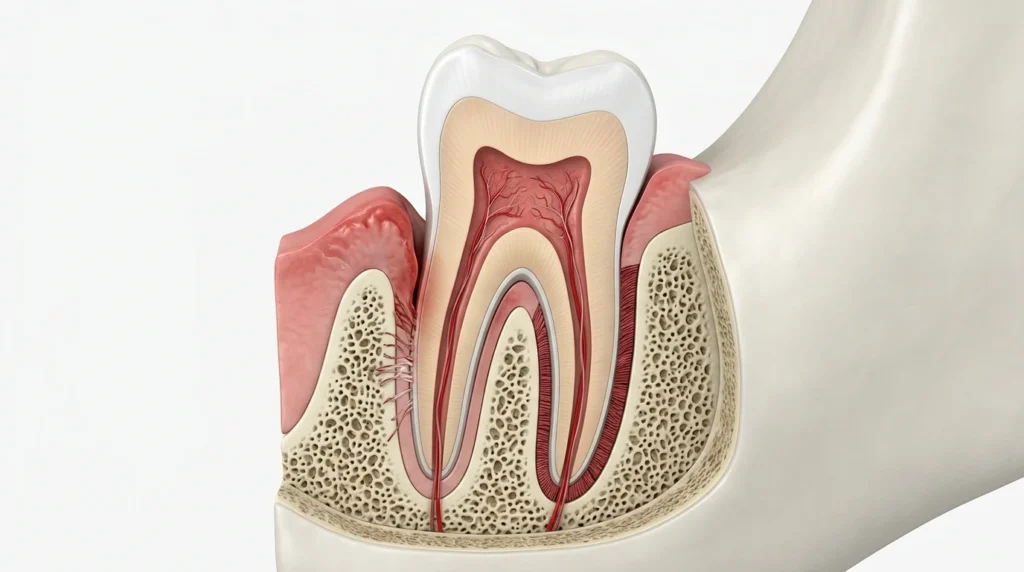
The wobbly tooth is a childhood rite of passage, and the family debate about whether to pull it is nearly as old as the tooth fairy. That debate is worth settling properly, because the same words, “my tooth is loose,” describe two completely different situations. In a six-year-old, a loose lower front tooth is the body doing exactly what it planned: the permanent tooth beneath has dissolved the milk tooth’s root, and what remains is a crown held by soft tissue, ready to come out. In a thirty-six-year-old, a loose tooth has no such plan behind it. Permanent teeth are anchored by a full-length root, a ligament and bone; if one moves, something has damaged that anchor, and the tooth is sending an alarm rather than saying goodbye.
Understanding which situation you are in decides everything that follows. The child’s tooth needs patience and clean hands. The adult’s tooth needs a diagnosis, and often it needs it quickly, because the treatments that save a loose permanent tooth work best in the first days. This guide gives the honest rules for both: how to handle a child’s loose milk tooth without drama or infection, why an adult should never pull a loose tooth, what is usually loosening it, and the one situation where minutes matter.
Milk Tooth vs Permanent Tooth: The Rule That Decides Everything
Situation | Safe to remove at home? | Why |
Child’s milk tooth, wobbling freely, painless | Yes, gently | The root has already dissolved; only gum holds it |
Child’s milk tooth, slightly loose but still firm | No, wait | The root is still partly there; forcing it can break it or hurt the tooth beneath |
Child’s milk tooth loose after a fall or knock | No, see a dentist | Injury loosening is different from natural loosening; the developing tooth below may be affected |
Child’s permanent tooth loose (age 6 and up) | Never | Permanent teeth do not loosen naturally at any age |
Adult tooth, any degree of looseness | Never | Signals gum disease, injury, grinding or infection; often saveable |
The test for a child’s milk tooth is simple. If it moves easily forward, backward and sideways, twists a little, sits visibly lower or higher than its neighbours and the child can push it with their tongue without wincing, it is ready. If it moves only slightly, or moving it hurts, it is not, and a week or two of normal eating usually finishes the job the body started. Children between 6 and 12 lose their 20 milk teeth in a predictable order, which we mapped in our baby teeth chart; a tooth loosening outside that order or age is worth a quick look.
How to Remove a Child’s Ready Milk Tooth Safely
Wash your hands, or better, let the child do it themselves, because they will stop at exactly the moment it hurts. Hold the tooth with a clean piece of gauze or tissue for grip, wiggle it gently in each direction, then twist lightly; a ready tooth comes away with almost no resistance. Expect a small amount of bleeding: press a clean folded gauze over the spot for a few minutes and it stops. Rinse gently with water, avoid very hot food for the rest of the day, and let the child eat normally otherwise. What you should not do is tie string to a door handle, use pliers, or yank a tooth that resists; those old methods are how a root fragment gets left in the gum, and how a child learns to fear the dentist before ever meeting one. Crunchy foods like an apple or a roti crust often finish a nearly ready tooth on their own, which is the gentlest method of all. If a milk tooth stays stubbornly in place while the permanent tooth is already visible behind or beside it, a dentist removes it in a minute; that “shark tooth” appearance is common and easily sorted, but left for months it can push the permanent tooth into a crooked position.
Why an Adult Tooth Loosens, and Why You Must Not Pull It
Cause | How it loosens the tooth | What a dentist can do |
Gum disease (most common) | Infection destroys the bone and ligament holding the root | Deep cleaning, gum treatment, splinting; early cases firm up again |
Injury or knock | Ligament stretched or torn, root or bone possibly fractured | Reposition and splint to neighbours for 2 to 4 weeks; root canal if the nerve dies |
Night grinding or clenching | Constant overload widens the socket | Night guard, bite adjustment; tooth often stabilizes |
Abscess at the root tip | Pus pressure lifts the tooth in its socket | Root canal or drainage; tooth settles as infection clears |
Pregnancy hormones | Ligaments temporarily softer; usually mild | Monitoring; resolves after delivery |
Advanced bone loss around the tooth | Little root left in bone | Extraction when hopeless, then replacement |
Notice the pattern in the right-hand column: most loose adult teeth are treatable, and several become firm again once the cause is removed. That is exactly what pulling at home throws away. A tooth loosened by gum disease still has a live root and a partially attached ligament; forcing it out snaps the root, leaves fragments in the bone, and turns a manageable infection into a socket infection. A tooth loosened by injury is the most tragic case, because a dentist can often push it back into position and splint it to its neighbours the same day, and it heals. The rule is absolute: a loose permanent tooth is a reason to book an urgent appointment, not a reason to reach for it. Bleeding, swollen or receding gums alongside the looseness point strongly to gum disease, a pattern we explained in our guide on bleeding and swollen gums, and treating the gums is what stops the next tooth from following.
The Knocked-Out Tooth: The One Case Where Minutes Matter
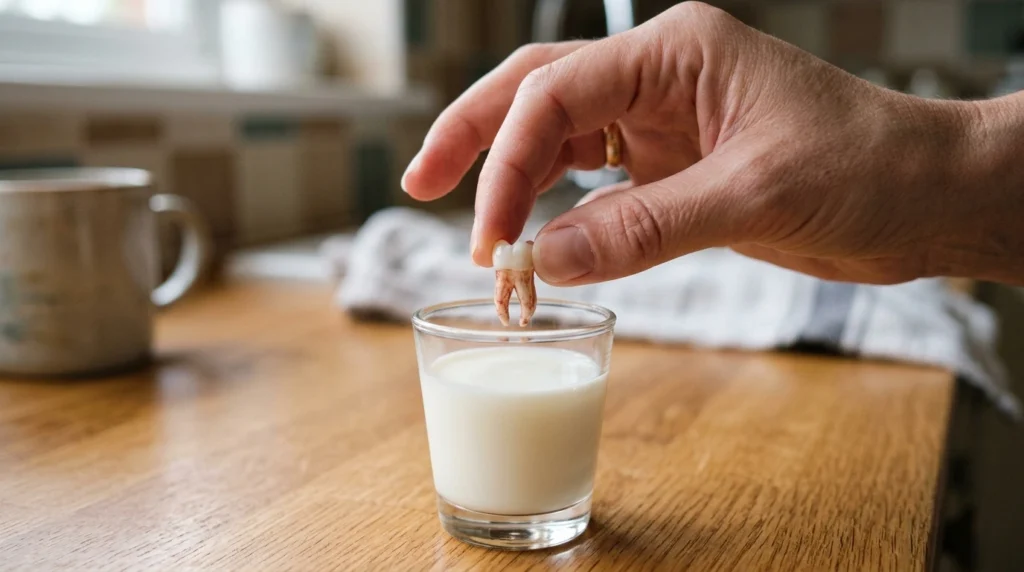
If a permanent tooth is knocked completely out by a fall, a ball or a fight, it can often be replanted, but only if it reaches a dentist within roughly 30 to 60 minutes and has been handled correctly. Pick it up by the crown, never the root. Do not scrub it. If it is dirty, rinse it for a second or two in milk or the person’s own saliva, not tap water for long. If the person is a calm adult, place the tooth back in its socket and have them bite gently on a cloth to hold it; if not, keep it in a cup of milk or tucked inside the cheek and go straight to an emergency dentist. A knocked-out milk tooth is different: it is not replanted, because doing so can damage the permanent tooth forming underneath, but the child should still be seen the same day to check for fragments and injury to the tooth below. Anything short of a fully knocked-out tooth, a tooth pushed sideways, pushed up, chipped or loosened, follows the same urgency; splinting works best within the first day, which is why a broken or displaced tooth belongs at a clinic today rather than “if it does not settle.”
After the Tooth Is Out: What Happens to the Gap
A child’s gap fills itself; the permanent tooth normally appears within weeks to a few months, and a gap that stays empty beyond about 6 months deserves an X-ray to confirm the tooth is coming. An adult’s gap does not fill itself. The neighbouring teeth tilt into it and the tooth above or below drifts toward it, which changes the bite within a year and makes later replacement harder. If a loose adult tooth genuinely could not be saved and was removed by a dentist, the conversation about a bridge, denture or implant should happen at the same visit rather than years later, when the space has already changed, an honest reality we covered in our overview of missing teeth treatment options.
Frequently Asked Questions
Is it safe to pull a loose tooth at home?
Only a child’s milk tooth that is wobbling freely and causes no pain. Wiggle it gently with clean hands or a clean tissue; it should come out with almost no force. Never pull a permanent tooth in a child or adult, and never force a milk tooth that still resists.
Why is my tooth loose as an adult?
The most common cause is gum disease destroying the bone around the root. Other causes are injury, night grinding, an abscess at the root tip, and, temporarily, pregnancy hormones. All of these need a dentist; several are reversible if treated early, and the tooth often firms up again.
Can a loose adult tooth tighten back up?
Often, yes. Teeth loosened by injury can be splinted and heal within weeks; teeth loosened by early gum disease firm up after deep cleaning; teeth overloaded by grinding stabilize with a night guard. The exception is advanced bone loss, where too little root remains in bone to hold the tooth.
What should I do if my child’s tooth is loose but not falling out?
Wait. Encourage normal eating, including crunchy foods, and let the child wiggle it with a clean tongue or finger. Most ready teeth fall out within a couple of weeks. See a dentist if the permanent tooth is already visible behind it, if it has been loose for months without progress, or if it loosened after a fall.
What do I do if a tooth is knocked out completely?
For a permanent tooth: hold it by the crown, rinse briefly in milk if dirty, place it back in the socket or keep it in milk, and reach a dentist within 30 to 60 minutes; it can often be replanted. For a milk tooth: do not replant it, but have the child seen the same day.
