
Quick Answer
Start cleaning a child’s mouth before the first tooth, brush twice a day with a fluoride toothpaste from the day the first tooth appears (a smear the size of a grain of rice under age 3, a pea-sized amount from 3 to 6), never put a child to bed with a bottle of milk, formula, juice or sweetened tea, keep sweet foods and drinks to mealtimes rather than through the day, brush or supervise brushing yourself until the child is at least 7 or 8, and the American Academy of Pediatrics notes many children need help until around 10, and book the first dentist visit by the first birthday or within six months of the first tooth. Baby teeth decay far faster than adult teeth because their enamel is thinner, and a cavity in a milk tooth is not harmless just because the tooth will fall out: it causes pain, infection, and damage to the adult tooth forming beneath it, and it is the strongest predictor that the child will have cavities as an adult.
The belief that milk teeth do not matter is the single most damaging idea in children’s dental care in Pakistan, and it is very common. Parents who are careful about everything else will say “yeh to doodh ke daant hain, gir jayenge,” and delay the dentist until the child is in pain, by which time a tooth that could have been saved with a small filling needs a root treatment or an extraction, often under sedation in a frightened four-year-old. Milk teeth are not placeholders. They hold the space for the adult teeth, guide them into position, allow the child to chew properly and speak clearly, and they carry the adult tooth bud directly beneath their roots, so an abscess in a baby molar can permanently mark or deform the adult tooth growing under it.
The other reason children’s teeth matter is habit. The child who is brushed twice a day from infancy, who does not drink sweet things through the day, and who has met a dentist before anything hurts becomes an adult with the same habits and a fraction of the dental problems. This guide gives the care routine by age, explains why baby teeth decay so quickly and the specific Pakistani habits that cause most of it, shows what an early cavity looks like so you can catch it, sets out how to teach a child to brush and how much toothpaste to use, and describes when the first dentist visit should happen and what it involves. Our baby teeth chart covers when each tooth arrives and falls out, which this guide assumes.
Care Routine by Age
Age | What to do | What to avoid |
Birth to first tooth (0 to 6 months) | Wipe gums once a day with a clean damp cloth or gauze wrapped round a finger; establishes the habit | Dipping the pacifier in honey, sugar, ghutti or gripe water |
First tooth to 12 months | Brush twice a day with a soft baby brush and a rice-grain smear of fluoride toothpaste (1,000 ppm); last thing at night after the final feed | Bottle in bed; sweetened milk or tea in the bottle; juice in a bottle or sipper |
1 to 3 years | Twice daily brushing by the parent, rice-grain smear until age 3; first dentist visit by the first birthday; move from bottle to open cup by 12 to 18 months | Sipper cups of juice or sweet milk carried around all day; sharing spoons or cleaning the dummy in your own mouth |
3 to 6 years | Pea-sized fluoride toothpaste (1,000 to 1,450 ppm); child may start but parent finishes; start flossing where back teeth touch; dentist every 6 months; fluoride varnish at visits | Letting the child brush unsupervised; rewarding with sweets; sticky snacks between meals |
6 to 8 years | First adult molars arrive behind the milk teeth; brush them deliberately; consider fissure sealants; supervise brushing until at least 7 or 8 | Assuming the child can brush alone because they say so |
8 to 12 years | Child brushes independently but parent checks; sealants on second molars around age 12; a first orthodontic check by age 7 (American Association of Orthodontists) if teeth are crowded or the bite looks wrong | Fizzy drinks, energy drinks and sweet chai as daily habits |
The two ages where most damage is done are 1 to 3 and 6 to 8. In the toddler years, the bottle and the sipper cup do the harm, quietly, at night, when saliva flow drops and sugar sits on the teeth for hours. At 6 to 8, the first adult molars erupt at the back of the mouth, behind the last milk molar, and because no milk tooth fell out to announce them, most parents and children do not know they are there; they are missed by the brush for months, and they are the teeth most often filled in Pakistani schoolchildren.
Why Baby Teeth Get Cavities So Fast
Cause | How it damages teeth | What to change |
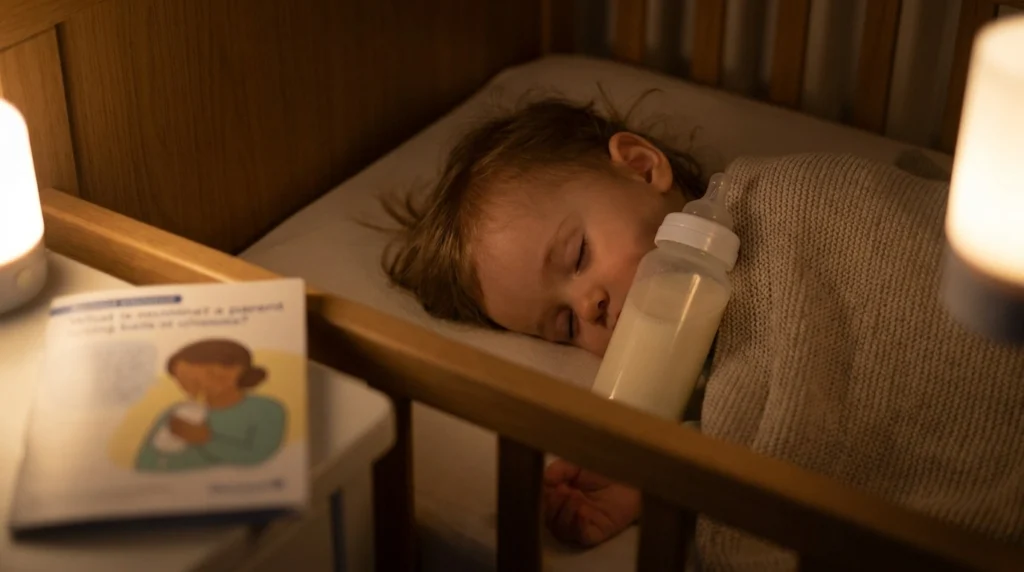
Bottle or breastfeeding to sleep, especially through the night | Milk pools around the upper front teeth for hours while saliva is low; classic “bottle caries” of the front teeth | Finish the feed, wipe or brush, then bed; water only in a night bottle if one is needed |
Sweetened milk, tea or “doodh patti” in the bottle or cup | Sugar plus long contact; chai in a bottle is very common in Pakistan and very damaging | Plain milk; no chai for young children; if given, at mealtimes in a cup |
Juice, cold drinks or flavoured milk in a sipper cup all day | Each sip restarts a 20 to 30 minute acid attack; a sipper carried around is 30 attacks a day | Water in the sipper; juice, if at all, diluted and only with a meal |
Sticky snacks between meals: biscuits, toffees, chips, nimko, dates, raisins | Stick in the grooves of molars and feed bacteria for hours | Snacks at set times; fruit, cheese, nuts, roasted chana; rinse with water after |
Thin enamel of milk teeth | Enamel is about half the thickness of adult enamel, so decay reaches the nerve in months, not years | Fluoride toothpaste from the first tooth; fluoride varnish at the dentist |
Bacteria passed from parent | Decay-causing bacteria transfer through shared spoons, blowing on food, cleaning a dummy in the mouth, kissing on the lips | Treat your own cavities; do not share utensils; clean the dummy with water |
Brushing only in the morning | The night is when sugar does its damage | Night brushing is the one that matters most |
Toothpaste with no fluoride, or “herbal” and “kids’ fruit” pastes without it | No protection; some Pakistani kids’ pastes are fluoride-free | Check the tube: 1,000 ppm fluoride minimum |
Medicines and syrups with sugar given at night | Cough syrups, paracetamol syrup and vitamins are sweet | Give before brushing, not after; ask for sugar-free versions |
Dry mouth from mouth breathing, blocked nose, some medicines | Less saliva to wash away acid | Treat the nose; water at bedside |
Almost every case of severe decay in a Pakistani toddler comes from the first three rows: a bottle of milk or chai at bedtime and a sipper of something sweet through the day. The pattern it produces is distinctive, brown or black decay across the upper front teeth and the biting surfaces of the first molars, in a child under three, and it is entirely preventable. The reasons a cavity forms are the same in a child as in an adult, which our guide to what actually causes tooth decay explains; what differs in children is the speed, because of the thin enamel, and the exposure, because of the bottle.
What an Early Cavity Looks Like in a Child
Look at the child’s teeth in daylight once a week, lifting the top lip to see the front teeth at the gumline and asking the child to open wide for the molars. The earliest sign is a dull chalky white line or patch along the gumline of the upper front teeth, where the enamel has lost mineral but has not yet broken; at this stage fluoride varnish and a change in the bottle habit can reverse it. The next stage is a yellow or light brown discolouration in the same place or in the grooves of a molar, followed by a dark spot or a visible hole. Children rarely complain until the decay is deep, so pain is a late sign; earlier signs are a child chewing on one side, refusing cold or sweet foods, holding the cheek, bad breath that brushing does not fix, or a small pimple on the gum near a tooth, which means abscess. Our guide to cavity symptoms covers what to look for in more detail. A dark spot on a milk tooth is never “just a stain” until a dentist has confirmed it.
Teaching a Child to Brush
Age | Who brushes | Technique and tips |
Under 2 | Parent | Child on your lap facing away, or lying with head in your lap; small soft brush; gentle circles on every surface; sing or count to make it a routine; expect protest, keep it short and consistent |
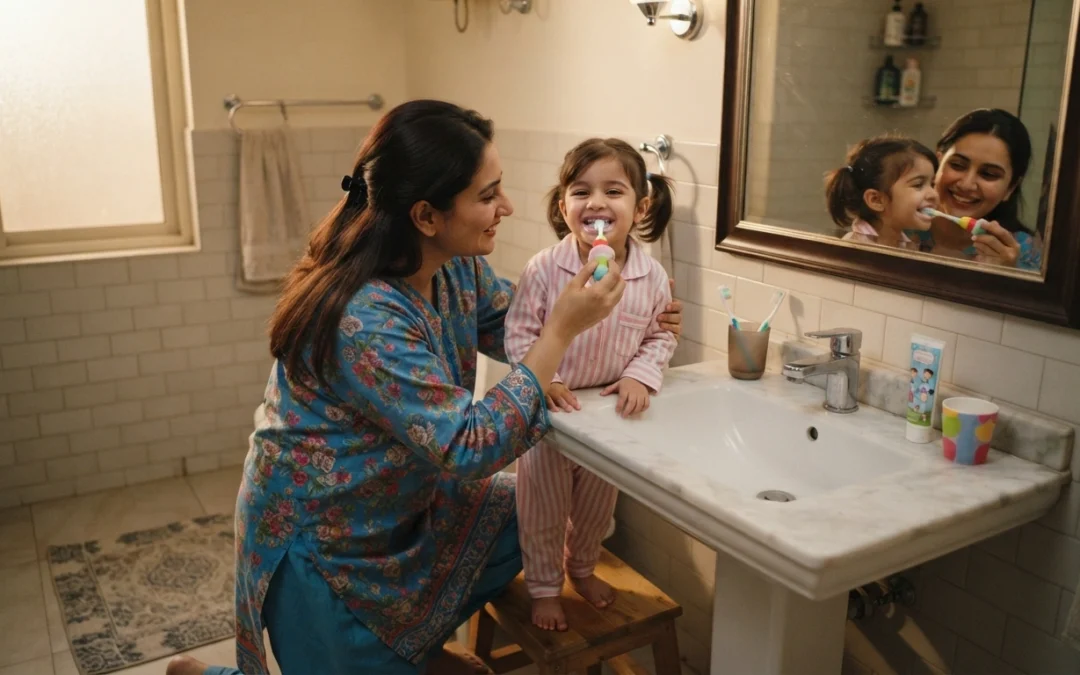
2 to 4 | Parent, child “helps” | Let the child hold a second brush and copy you in the mirror, then you finish properly; brush your own teeth alongside; two minutes, twice a day |
4 to 7 | Child starts, parent finishes | Child brushes first, then the parent re-brushes, especially back molars and inner surfaces; a two-minute timer or song; spit, do not rinse, so fluoride stays on |
7 to 10 | Child brushes, parent checks | Children lack the wrist control to brush well before about 7, and the AAP suggests supervision until around 10; check the gumline of the back teeth with a torch; introduce floss or floss picks where teeth touch |
10 and up | Independent | Occasional spot checks; electric brushes help children who brush badly; see our comparison of electric vs manual toothbrushes |
The rule most Pakistani parents find hardest is “spit, don’t rinse.” Rinsing with water after brushing washes the fluoride off before it can work; a child should spit out the foam and leave it, and should not eat or drink for 30 minutes after night brushing. The second hardest is not stopping early. A child who has “brushed” for 20 seconds, front teeth only, has not brushed, and until 7 or 8 a parent’s hand on the brush for the final pass is the only way the back molars are cleaned. Making brushing a fixed part of the bedtime sequence, after the last feed or drink and before the story, does more than any amount of persuasion.
The First Dentist Visit
The first visit should happen by the child’s first birthday, or within six months of the first tooth, whichever comes first, and it should happen before anything hurts. That timing surprises parents in Pakistan, where the first visit is usually prompted by pain at four or five, but the purpose of the early visit is not treatment. The dentist checks that the teeth are erupting normally, looks for the early white-spot lesions that a parent will miss, applies fluoride varnish, and, most importantly, talks through the bottle, the sipper, the chai and the toothpaste while there is still time to change them. The child sits in the parent’s lap, the visit is short and gentle, and it means that when the child does eventually need a filling, the dentist and the chair are familiar rather than frightening.
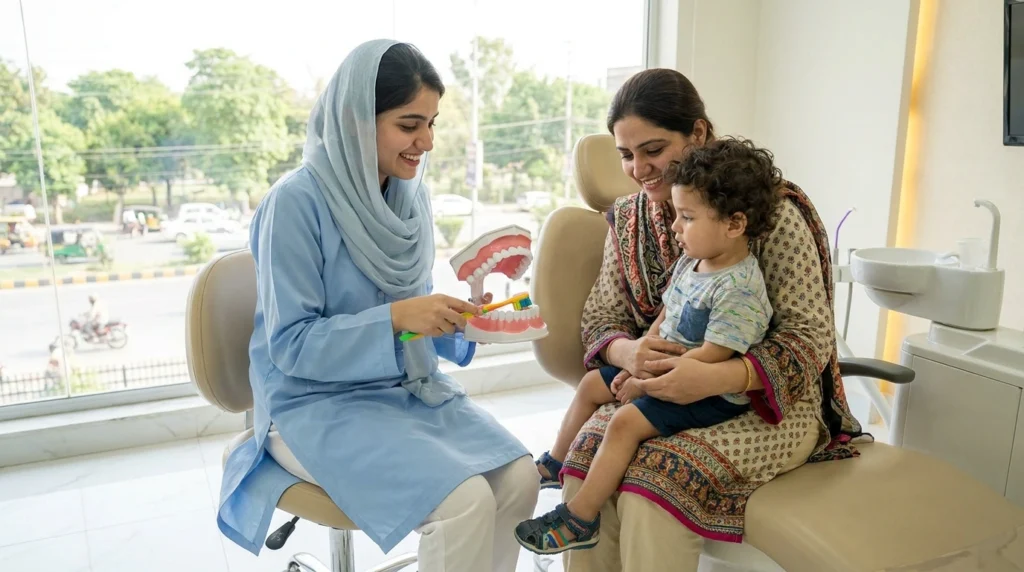
Prepare the child by describing it simply and positively, avoiding words like “hurt,” “injection” or “drill” even in reassurance, and not using the dentist as a threat for not brushing. Book a morning appointment when the child is rested and fed. From then on, a check-up every six months with fluoride varnish, and fissure sealants on the adult molars as they arrive at around 6 and 12, prevents most of the decay that would otherwise need fillings. If your child has never seen a dentist and is already over two, the right time is this month, not when the first toothache comes; you can book an appointment with our children’s team and we will keep the first visit short, calm and free of anything that hurts.
Frequently Asked Questions
When should I start brushing my baby’s teeth?
From the day the first tooth appears, usually around 6 months, twice a day with a soft baby brush and a smear of fluoride toothpaste the size of a grain of rice. Before the first tooth, wipe the gums daily with a clean damp cloth to build the habit.
How much toothpaste should a child use?
A rice-grain smear of 1,000 ppm fluoride toothpaste under age 3, and a pea-sized amount of 1,000 to 1,450 ppm from 3 to 6. Teach the child to spit and not rinse. Check the tube, because some children’s pastes sold in Pakistan contain no fluoride and give no protection.
Do cavities in baby teeth need to be filled if the tooth will fall out?
Yes. Milk molars are in the mouth until 10 to 12, and an untreated cavity causes pain, infection, abscess and damage to the adult tooth developing underneath. Early treatment is a small filling; late treatment is a root treatment or extraction, and a lost milk molar lets neighbouring teeth drift and crowd the adult teeth.
Why does my child get cavities even though we brush every day?
Usually because of what happens between brushes: a bottle at night, sweet chai or juice in a sipper through the day, sticky snacks, or a toothpaste without fluoride. Brushing removes plaque but cannot undo six hours of milk on the teeth overnight. Night brushing after the last feed, and water in the bottle, are the two changes that matter most.
When should a child first see a dentist?
By the first birthday or within six months of the first tooth, then every six months. The first visit is a check and a conversation, not treatment; it catches early decay while it can still be reversed with fluoride, and it makes later visits familiar rather than frightening.
