
Cavities and Decay: How Tooth Decay Actually Progresses Stage by Stage
Cavities and decay are talked about so often that most people assume they already understand them, right up until a dentist points to an x ray and shows decay in a spot that felt completely fine. The reality is that a cavity is not a single event, it is a slow moving process that passes through distinct stages, and what treatment is needed depends entirely on which stage the decay has actually reached. This guide walks through exactly how cavities and decay progress from the very first invisible damage to a full blown infection, what each stage actually feels like, and why catching the process early makes such a large difference in what treatment ends up being necessary.
What Cavities and Decay Actually Are
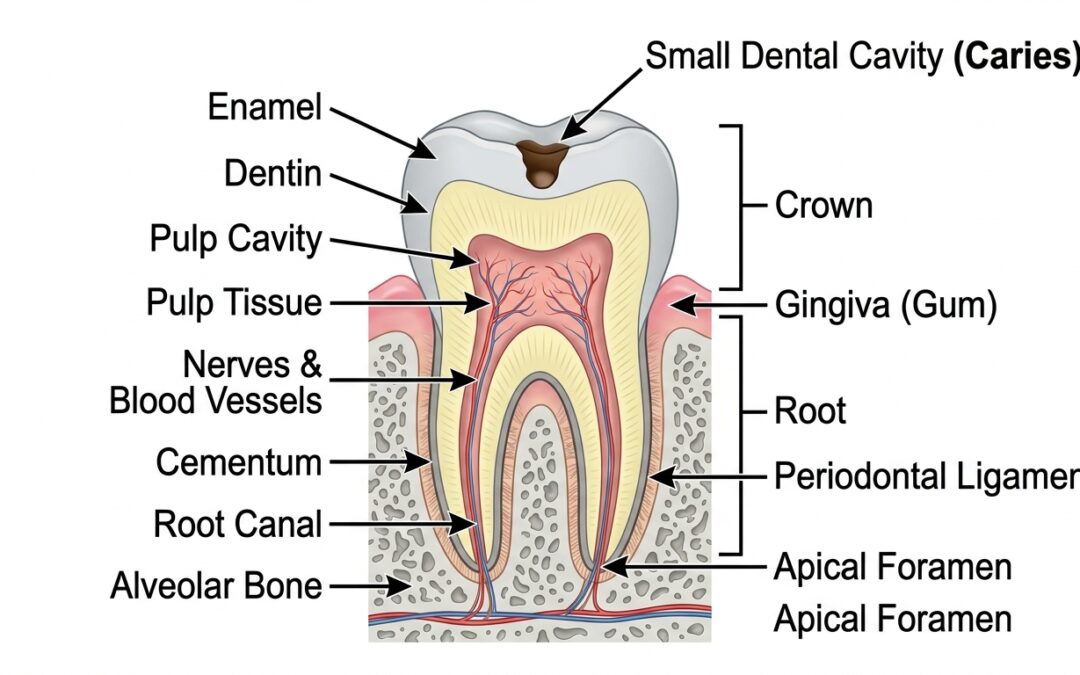
Decay begins with bacteria that naturally live in everyone’s mouth. These bacteria feed on sugar and starch left behind from food and produce acid as a byproduct. That acid slowly dissolves the minerals in tooth enamel, and once enough mineral loss has happened in one spot, a cavity has formed, which is simply a hole created by this ongoing acid damage. Left alone, decay does not stay in one place. It keeps moving deeper into the tooth over time, which is exactly why the stage of decay matters so much more than most people realize.
Stage One: Early Demineralization
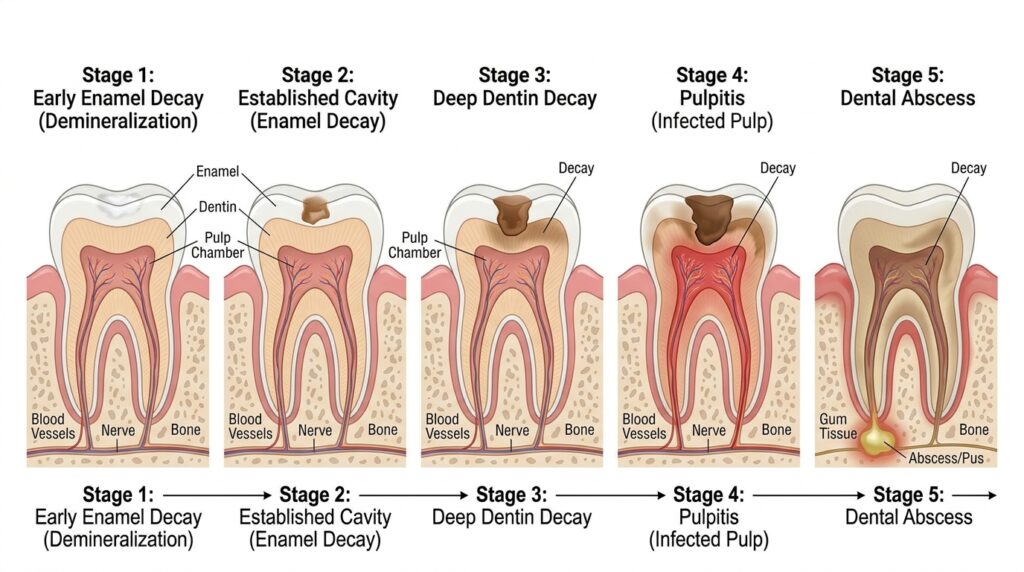
The very first stage of decay happens before a visible hole ever forms. Acid begins pulling minerals out of the enamel surface, sometimes showing up as a small white or chalky spot that is easy to miss entirely. At this stage there is usually no pain at all, and the damage is often reversible with fluoride treatment and better oral hygiene, since the tooth structure has not actually broken down yet, only lost some of its mineral content. This is the stage where catching decay early genuinely prevents a cavity from forming in the first place.
Stage Two: Enamel Decay
If demineralization continues without intervention, the enamel surface eventually breaks down and a true cavity begins to form. At this point the damage is no longer reversible on its own, though it is still limited to the outer enamel layer, which has no nerve endings. This means enamel stage decay usually still produces no pain, which is precisely why so many cavities are only caught during a routine checkup rather than because the patient noticed anything wrong. A small filling at this stage is typically a quick, straightforward fix.
Stage Three: Dentin Decay
Once decay pushes past the enamel and reaches the dentin layer underneath, everything changes. Dentin is softer than enamel and decays faster once acid reaches it, and because dentin connects more directly to the nerve, this is usually the stage where sensitivity to hot, cold, and sweet foods first appears. The pain at this point tends to be sharp and short lived, triggered by something specific rather than constant. Treatment is still typically a filling, though a somewhat larger one than would have been needed at the enamel stage, since more tooth structure has already been lost.
Stage Four: Pulp Involvement
If decay is still left untreated, it eventually reaches the pulp at the center of the tooth, where the nerve and blood supply live. This is a major turning point, since pulp involvement typically causes pain that becomes constant, throbbing, and much harder to ignore than the brief sensitivity of earlier stages. The pulp can become inflamed or infected at this stage, and a simple filling is usually no longer enough. Root canal treatment, which removes the infected tissue from inside the tooth while preserving the outer structure, becomes the standard treatment once decay has progressed this far.
Stage Five: Abscess Formation
Left untreated even further, infection at the pulp can spread beyond the tooth itself and form an abscess, a pocket of pus at the root tip. This is the most serious stage of untreated decay, producing deep throbbing pain that can pulse with your heartbeat, along with facial swelling, sensitivity to pressure, and sometimes fever. An abscess will not resolve without professional treatment, and because the infection can spread to surrounding tissue if ignored, this stage genuinely qualifies as a dental emergency rather than something to manage at home.
Why Pain Is Such an Unreliable Signal for Cavities and Decay
One of the most important things to understand about cavities and decay is that pain typically shows up very late in the process, well after significant damage has already occurred. The first two stages, where treatment is simplest and most conservative, usually produce no pain at all. By the time pain becomes noticeable, decay has often already reached the dentin or pulp, meaning the easiest window for simple treatment has already closed. This is exactly why relying on pain as your signal to visit a dentist means catching most cavities later than ideal.
How Cavities Are Actually Found Early
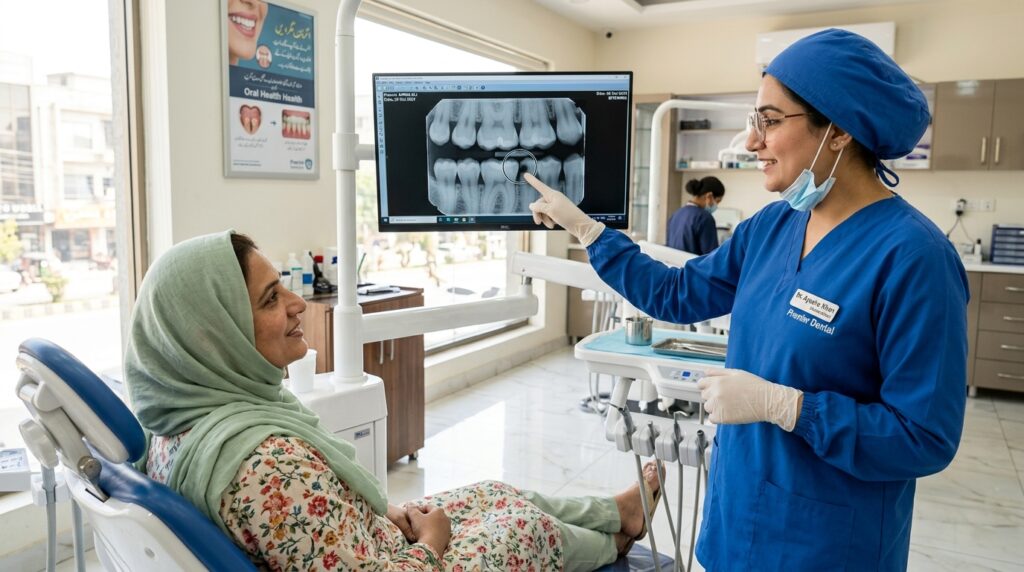
Since early decay rarely produces symptoms, routine checkups and x rays are what actually catch cavities and decay while treatment is still simple. A dentist can spot early demineralization visually during an exam, and x rays reveal decay between teeth or beneath old fillings long before it would ever become painful. This is the core reason checkups every six months matter even when nothing feels wrong, since the entire value of a checkup is catching problems before they reach the stage where you would notice them yourself.
Which Teeth Are Most Prone to Cavities and Why
Not every tooth carries equal risk. Back molars have deep grooves that trap food and bacteria more easily than smoother front teeth, making them the most common site for decay. The spaces between teeth are also high risk, since they are harder to clean thoroughly with brushing alone and often need flossing to actually reach. Teeth near old fillings or crowns carry additional risk if the seal at the edge of the restoration has started to break down, allowing bacteria back in around the margin.
Cavities and Decay in Children Versus Adults
Decay in baby teeth moves faster than in adult teeth because baby tooth enamel is noticeably thinner, meaning a cavity can progress from early demineralization to a painful stage in a shorter span of time. This is part of why pediatric dental checkups are recommended just as regularly as adult ones, since a small cavity that would take a year or more to become serious in an adult tooth might reach the same point in a fraction of that time in a child. Adults, meanwhile, face additional risk factors like gum recession exposing root surfaces, which have no enamel at all and decay especially quickly once affected.
Treatment Options Matched to Each Stage
Because cavities and decay progress through such distinct stages, treatment genuinely depends on catching the right point in that progression. Early demineralization often reverses with fluoride and improved hygiene alone. Enamel and early dentin decay typically need a straightforward filling. Deeper dentin decay approaching the pulp may need a slightly larger restoration or, depending on severity, [restorative treatment](https://dentalexperts.pk/best-medicine-for-tooth-pain-choosing-the-right-solution-for-toothache/) beyond a simple filling. Pulp involvement generally requires root canal treatment, and an abscess needs drainage, root canal therapy, or in more advanced cases extraction, sometimes alongside antibiotics to control a spreading infection first.
Preventing Decay From Progressing Through These Stages
Since decay only ever moves forward without treatment, prevention is entirely about stopping the process at the earliest possible point. Brushing twice daily with fluoride toothpaste and flossing once a day remove the plaque that produces the acid responsible for decay in the first place. Cutting back on frequent sugary and starchy snacking reduces how much fuel that bacteria actually has to work with throughout the day. [Routine cleanings and checkups](https://dentalexperts.pk/scaling-root-planning-polishing/) every six months catch demineralization and early enamel decay while they are still simple, reversible, or easily filled, long before they have any chance of reaching the painful later stages.
Why Two People Can Have Very Different Decay Timelines
It is worth being clear that there is no fixed schedule for how cavities and decay progress, since the actual speed depends on several factors working together at once. Someone with frequent sugary snacking, thin saliva flow, and inconsistent brushing can move from early demineralization to a painful cavity within months, while someone with strong oral hygiene and infrequent sugar exposure might carry the same early stage decay for years without much change. Genetics also plays a real role, since enamel thickness and saliva composition vary between individuals in ways that are simply inherited rather than earned through habits. This is exactly why comparing your own situation to someone else’s timeline rarely tells you anything useful, and why a personal checkup remains the only reliable way to know where your own teeth actually stand.
What to Do If You Suspect a Cavity Right Now
If you have noticed a new area of sensitivity, a visible dark spot, or a rough patch on a tooth, the safest step is a proper exam rather than waiting to see if it becomes painful, since by the time pain shows up, the simplest treatment window has often already passed. Booking a [toothache treatment](https://dentalexperts.pk/teeth-pain/) visit at this point, even for something that feels minor, is almost always the difference between a quick filling and a much larger procedure a year or two down the line.
Frequently Asked Questions
Kya cavity apne aap theek ho sakti hai?
Only at the very earliest stage, called demineralization, before a true hole has formed. Once enamel has actually broken down into a cavity, it cannot heal on its own and needs a filling or further treatment depending on how deep it has progressed.
How long does it take for a cavity to reach the nerve?
This varies significantly based on the tooth, diet, and oral hygiene, ranging anywhere from several months to a few years, which is exactly why regular checkups matter, since there is no reliable way to predict the timeline for any specific cavity without an exam.
Can you feel a cavity before it causes pain?
Sometimes a rough patch, a visible dark spot, or mild sensitivity to sweets can be noticed before real pain develops, but many early cavities produce no noticeable symptoms at all, which is why they are usually found during routine checkups rather than self detected.
Do cavities between teeth need different treatment than cavities on the surface?
The treatment principle is the same, removing decay and filling the space, but cavities between teeth are harder to detect early since they are hidden from direct view, which is why x rays specifically matter for catching this type of decay.
Is decay in a baby tooth worth treating if the tooth will fall out anyway?
Yes, since an untreated infected baby tooth can affect the permanent tooth developing underneath it, and the pain and infection risk are just as real in a baby tooth as in a permanent one while it is still in the mouth.
