

Quick Answer
Babies get 20 milk teeth in total. The first tooth usually appears between 6 and 10 months, starting with the two lower front teeth, and the full set is in place by age 3. These teeth then fall out between ages 6 and 12 in roughly the same order they arrived, making room for 32 permanent teeth. A delay of a few months on any of these ages is completely normal.
Every parent counts teeth. It is one of the first milestones families track, and also one of the first things they worry about when a neighbor’s baby has four teeth and theirs has none. The honest reassurance up front: eruption ages vary enormously between healthy children, and a chart is a guide, not a deadline. What matters far more than timing is what happens to those teeth once they arrive, and that part is covered further down along with the full range of children’s dental services available when something does need professional attention.
Milk teeth are not practice teeth. They hold space for the permanent set, guide jaw growth, and shape speech and chewing for the most important developmental years. A milk tooth lost early to decay lets neighbors drift into the gap, and the permanent tooth underneath then erupts crooked. Understanding what actually causes tooth decay in the first place is half the protection, because the same sugar and bacteria mechanics apply at age 2 as at age 40.
The Chart: When Each Baby Tooth Comes In
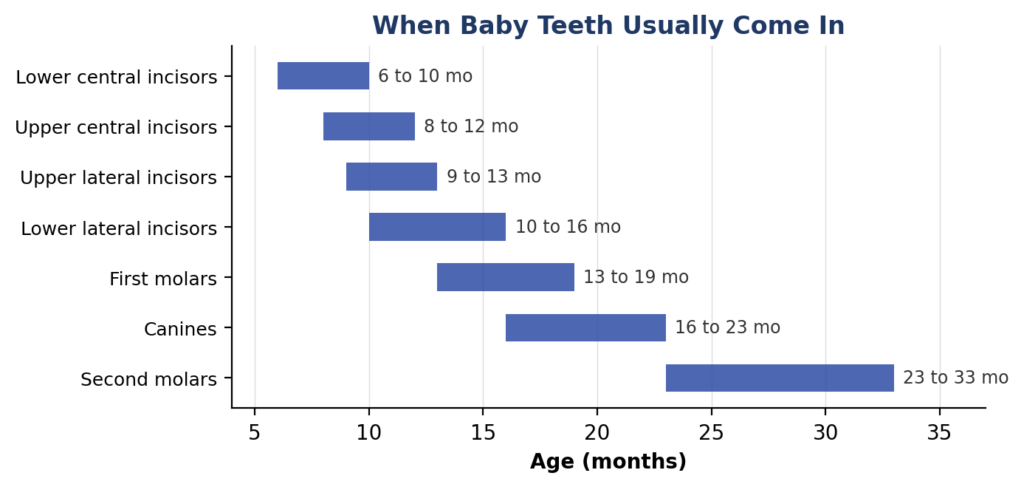
Tooth | Comes in (months) | Falls out (years) |
Lower central incisors | 6 to 10 | 6 to 7 |
Upper central incisors | 8 to 12 | 6 to 7 |
Upper lateral incisors | 9 to 13 | 7 to 8 |
Lower lateral incisors | 10 to 16 | 7 to 8 |
First molars | 13 to 19 | 9 to 11 |
Canines | 16 to 23 | 9 to 12 |
Second molars | 23 to 33 | 10 to 12 |
Girls usually run slightly ahead of boys, lower teeth usually arrive before their upper pairs, and teeth generally come in matching left and right pairs. If a tooth has not appeared within about 6 months of the outer edge of its range, mention it at the next checkup; if no teeth at all have appeared by 18 months, book a dental visit specifically for it.
Teething: What Is Normal and What Is Not
Normal teething brings drooling, chewing on everything within reach, sore red gums, mild fussiness and lightly disturbed sleep, typically for a few days around each new tooth. A cold teething ring or a clean cold cloth to chew genuinely helps. What teething does not cause is high fever, diarrhea or vomiting; those are illness, not teeth, and blaming teething delays real treatment. Teething gels with benzocaine are not recommended for infants, so skip them unless a doctor specifically prescribes an alternative.

Protecting Milk Teeth From Day One
Age | What to do |
Before first tooth | Wipe gums with a clean damp cloth after feeds. No bottle in bed with milk or juice |
First tooth to age 3 | Brush twice daily with a rice grain smear of fluoride toothpaste. First dental visit by the first birthday |
Age 3 to 6 | Pea sized fluoride toothpaste, parent does the brushing, child gets a turn after. No sugary drinks in feeders |
Age 6 onward | Child brushes with supervision, flossing where teeth touch, checkups every 6 months |
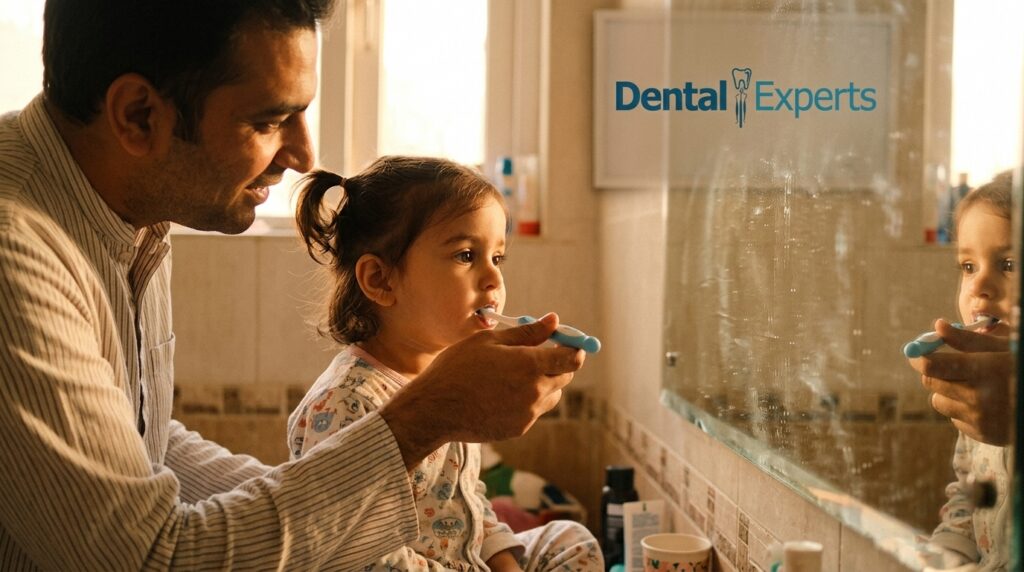
The bottle in bed habit deserves its own sentence because it quietly destroys more Pakistani toddlers’ teeth than anything else. Milk pooling around teeth all night is a sugar bath, and the pattern it causes even has a name, nursing bottle caries: the upper front teeth rot first while the lower ones stay fine. Water in the night bottle, always. And because early cavities in milk teeth are easy to miss until they hurt, it helps to know the cavity signs and treatment options so a small brown spot gets a filling instead of growing into a toothache.
When Baby Teeth Fall Out
The first wobbly tooth usually arrives around age 6, and the sequence loosely mirrors the arrival order: front teeth first, molars and canines last, finishing around age 12. Let loose teeth fall on their own schedule; forcing one out early breaks the root and risks infection. A permanent tooth sometimes erupts behind a milk tooth that has not fallen yet, the shark teeth look, and it almost always resolves once the milk tooth drops. If the double row persists more than a few weeks, have a dentist look. Deep decay in a milk molar is also worth treating properly rather than pulling early, because that molar is holding space for years yet; in selected cases even a baby root canal treatment called a pulpotomy is the better choice than extraction, and a dentist will tell you honestly which applies.
Frequently Asked Questions
How many teeth do babies and children have?
Children grow 20 milk teeth, complete by about age 3. These are replaced between ages 6 and 12 by the permanent set, which totals 32 including wisdom teeth.
My baby is 12 months old with no teeth. Is that a problem?
Usually not; late eruption runs in families and most late starters catch up fully. If no tooth has appeared by 18 months, book a dental checkup for it.
Does teething cause fever?
Teething can cause a very slight temperature rise, but a real fever above 38C is illness, not teething, and should be treated as such.
When should a child first visit the dentist?
By the first birthday, or within 6 months of the first tooth appearing, whichever comes first. Early visits are short, cheap and build familiarity before anything ever hurts.
Do cavities in milk teeth matter if the teeth fall out anyway?
Yes. Decayed milk teeth cause real pain, infect the permanent tooth forming underneath, and losing them early makes the adult teeth come in crooked. They are worth filling.
