
Quick Answer
Root canal kya hota hai: a root canal treatment, or RCT, is the procedure that saves a tooth whose nerve, the pulp inside it, has become infected or has died, usually because decay reached it, the tooth cracked, or it was knocked. Under local anaesthetic the dentist opens the top of the tooth, removes the infected pulp from the chamber and the thin canals inside each root, cleans and disinfects those canals, shapes them, and seals them with a rubber-like filling called gutta-percha so bacteria cannot re-enter. The tooth is then rebuilt with a filling and, for back teeth, a crown. Done with modern anaesthetic, the procedure itself feels like having a long filling, and published reviews show that pain falls from about 81% of patients before treatment to around 40% the next day and 11% a week later. Most teeth need one or two visits of 45 to 90 minutes. Around 86 to 93% of root-treated teeth are still in the mouth 10 years later, and a well-made crown on a back tooth is the single biggest factor in keeping it there. The alternative is extraction, which is cheaper on the day and far more expensive once the gap has to be filled.
Few phrases frighten a Pakistani dental patient like “aap ka root canal hoga.” The reputation comes from a time before good local anaesthetics and modern instruments, and from the fact that most people meet the procedure at the worst possible moment, after nights of throbbing pain and a swollen face, so that the memory of the pain attaches itself to the treatment that ended it. The result is that many people choose to have the tooth pulled instead, or to swallow antibiotics and painkillers for months until the choice is made for them. Both decisions cost more teeth and more money than the root canal they were avoiding.
This guide explains in plain terms what the pulp is and why it dies, the signs that a tooth needs a root canal rather than a filling, exactly what happens at each step and in each visit, whether it hurts and what the evidence says about pain, how long a treated tooth lasts and what decides that, why the crown afterwards is not an optional extra, how RCT compares with extraction and an implant, and what it costs in Pakistan. Our separate root canal treatment cost guide gives the full price breakdown; this article is about the treatment itself.
Daant Ki Jarr Ka Ilaj: What the Pulp Is and Why It Dies
Every tooth is hollow. Under the hard enamel and the softer dentine beneath it sits a chamber, and from that chamber one to four narrow canals run down the length of each root to a tiny opening at the tip. The chamber and canals hold the pulp: nerves, blood vessels and connective tissue that built the tooth in childhood and now mainly serve to sense temperature and pressure. A fully formed adult tooth can live without its pulp, which is the whole basis of root canal treatment, because the tooth is held in the jaw by the ligament around its roots, not by the nerve inside it.
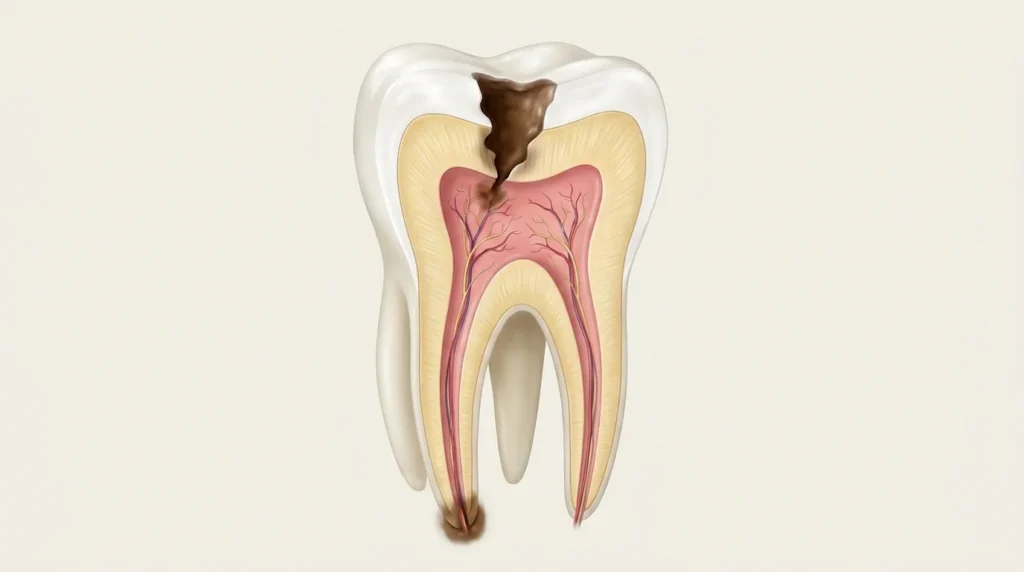
The pulp is sealed in a hard case with almost no room to swell, so when bacteria reach it, the inflammation that would be harmless in a finger becomes an agonising pressure inside a rigid box, and the blood supply through the narrow root tip is squeezed shut. The pulp then dies, and the dead tissue becomes a bacterial reservoir that drains out through the root tip into the jaw bone, where it forms an abscess. Decay is the commonest route, which is why a cavity that is filled early never needs a root canal and one that is ignored usually does; our guide on whether a cavity can be reversed explains the stages. A crack from grinding or biting something hard, a deep filling placed close to the pulp, a blow to the tooth, and repeated dental work on the same tooth are the other routes.
| Sign | What it means | Filling or root canal? |
| Brief sensitivity to cold that stops within a few seconds | Pulp irritated but healthy; exposed dentine or a small cavity | Filling or desensitising treatment |
| Pain with hot or cold that lingers 30 seconds or more after the stimulus is gone | Irreversible pulpitis: the pulp is inflamed beyond recovery | Root canal |
| Spontaneous throbbing pain, especially at night or when lying down | Irreversible pulpitis or early abscess | Root canal, often urgent |
| Pain on biting or tapping the tooth | Infection has reached the ligament and bone at the root tip | Root canal |
| Tooth has gone dark grey or brown compared with its neighbours | Pulp has died, often after an old injury | Root canal, even if painless |
| Swelling of the gum or face near the tooth | Abscess | Root canal after the infection is controlled; see our tooth abscess page |
| A small pimple on the gum that comes and goes, sometimes with a salty taste | Sinus tract draining a chronic abscess | Root canal; the tooth is infected even though it may not hurt |
| Deep decay that the dentist finds has reached the pulp when cleaning the cavity | Pulp exposed | Root canal, decided on the day |
| A dark shadow at the root tip on an X-ray with no symptoms | Chronic infection at the root tip | Root canal |
The lingering test is the one to remember. Sensitivity that stops as soon as the cold drink is swallowed is a filling problem. Pain that keeps going for half a minute or more after the cold has gone, or that wakes you at night, is a pulp problem, and a filling placed on top of it will not stop it.
Root Canal Treatment Step by Step
| Step | What the dentist does | What you feel | Why it matters |
| 1. X-ray and diagnosis | Takes a periapical X-ray, tests the tooth with cold and tapping, checks the gum | Nothing beyond the cold test | Confirms which tooth and how many roots and canals |
| 2. Local anaesthetic | Numbs the tooth and surrounding gum; for a very inflamed lower molar may add a second injection or an extra technique | A pinch, then numbness within 5 to 10 minutes | Modern anaesthetics make the rest of the visit painless; a “hot tooth” with severe pulpitis sometimes needs more anaesthetic and a few minutes longer |
| 3. Rubber dam | Stretches a small rubber sheet over the tooth, held by a clamp | Pressure from the clamp; the mouth stays dry | Keeps saliva and bacteria out and keeps instruments and disinfectant out of your mouth; a standard of care, not a luxury |
| 4. Access opening | Drills a small opening through the top of the tooth into the pulp chamber | Vibration, no pain | Gives a straight path into the canals |
| 5. Removing the pulp | Lifts out the pulp tissue with fine instruments | Nothing | Removes the infected or dead tissue |
| 6. Measuring the canals | Uses an electronic apex locator and an X-ray to find the exact length of each canal | Nothing | Cleaning must reach the tip but not beyond it |
| 7. Cleaning and shaping | Uses flexible nickel-titanium files, often in a slow handpiece, to clean the canal walls and widen them into a smooth taper | A faint ticking or buzzing | Removes bacteria in the dentine walls and makes a shape that can be sealed |
| 8. Irrigation | Flushes the canals repeatedly with sodium hypochlorite (dilute bleach) and other solutions | Nothing, under the dam | Dissolves tissue and kills bacteria in the places files cannot reach; the most important step for success |
| 9. Medicament and temporary filling (if two visits) | Places calcium hydroxide paste in the canals and a temporary filling on top | Nothing; mild tenderness for a day or two afterwards | Lets the infection and swelling settle before sealing; used for abscessed teeth |
| 10. Filling the canals (obturation) | Fills each canal with gutta-percha points and sealer, warmed or compacted to fill every space | Nothing | Seals the canals so bacteria cannot re-enter |
| 11. Core filling | Rebuilds the inside of the tooth with a strong filling material, sometimes with a post in the root | Nothing | Supports the crown |
| 12. Crown (back teeth, and front teeth with little structure left) | Shapes the tooth and fits a crown over it, usually at a separate visit one to three weeks later | A normal crown appointment | Protects the hollow, brittle tooth from fracture; see below |
A front tooth with a single canal and no abscess is often finished in one visit of 45 to 60 minutes. A back molar with three or four canals, or a tooth with an abscess, is usually done in two visits a week or two apart, each 60 to 90 minutes, with the calcium hydroxide step in between. Single-visit treatment of uninfected teeth and two-visit treatment of infected ones both have good evidence; the dentist decides on the day based on how clean and dry the canals are.
Does a Root Canal Hurt?
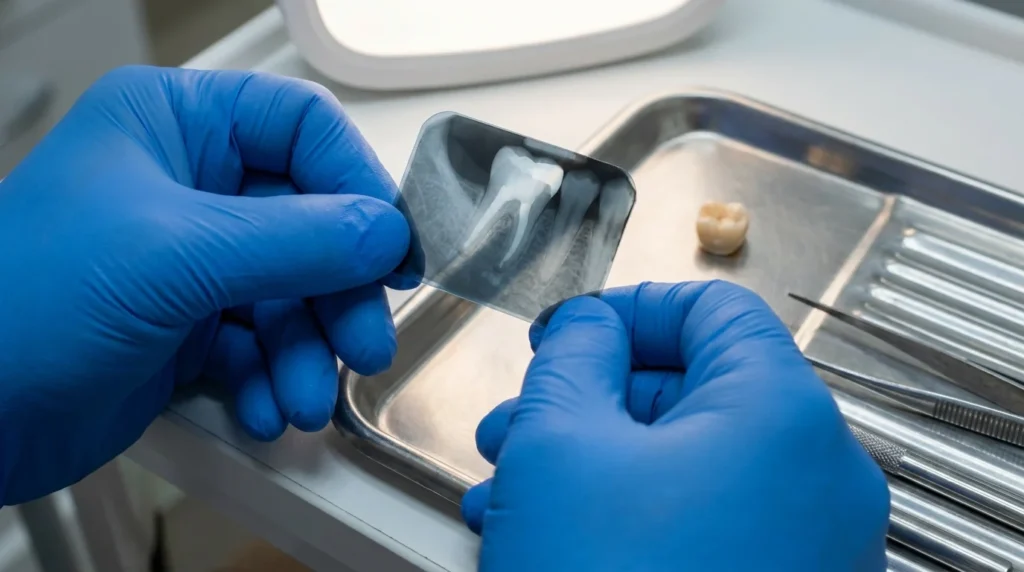
Under adequate local anaesthetic, the procedure itself feels like a long filling: pressure, vibration and the sound of the instruments, with no pain. The exception is the “hot tooth,” a lower molar with severe pulpitis in which inflammation makes the nerve hard to numb; the dentist knows this and uses additional anaesthetic techniques, and in some cases places a sedative dressing for a few days to calm the tooth before completing the work. You should tell the dentist the moment you feel anything, and a good one will stop and give more.
The pain people remember is almost always the pain before treatment, and the evidence is clear that treatment removes it. A systematic review of 30 studies published in the Journal of Endodontics found that 81% of patients had pain before root canal treatment, about 40% had some pain at 24 hours, and 11% at one week, with the authors describing the fall as moderate within a day and substantial, to minimal levels, within seven days. A large practice-based study in the United States found the same pattern: 81% in pain before, about 11% a week later. Some soreness on biting for two to four days is normal, because the ligament around the root tip is bruised by the cleaning, and it is managed with paracetamol or ibuprofen. Severe pain, swelling that increases after the second day, or a fever is not normal and needs a call to the clinic; it usually means a flare-up of infection that is treated with drainage or antibiotics. Avoid chewing on the tooth until the permanent filling or crown is in place, because a tooth with a temporary filling and no crown is at its weakest.
How Long a Root Canal Lasts, and Why the Crown Matters
| Measure | Result | Source |
| Tooth survival after root canal treatment | About 86% at 2 to 3 years, 93% at 4 to 5 years, 87% at 8 to 10 years | Systematic review, International Endodontic Journal 2010 |
| Survival in a specialist setting, first-time and repeat treatment | 95% at 4 years for both | Prospective study hosted by the American Association of Endodontists |
| Very long term | 97% at 10 years, 81% at 20 years, 76% at 30 years in one series followed up to 37 years | Published follow-up of 598 teeth |
| Complete healing of the infection at the root tip (a stricter measure than survival) | 74 to 85% | International Endodontic Journal |
| Root-treated teeth without a crown versus with a crown | Teeth without crowns were extracted about 6 times more often in one study; the European Society of Endodontology notes the study was retrospective and may carry some bias, but recommends crowning posterior teeth | Aquilino and Caplan 2002; ESE position statement 2021 |
| Crown within 6 months versus a filling only | Survival 93% with a crown against 90% with a filling only in a large insurance dataset | Journal of Dentistry 2015 |
The factors that most improve survival, in order, are a crown placed after treatment, having teeth on both sides of the treated tooth, the tooth not being used to hold a denture or bridge, and the tooth being a front tooth rather than a molar. The crown matters because a root-treated back tooth is hollow, has lost much of its structure to decay and the access opening, and has no nerve to warn you when you bite too hard; without a crown it splits, often down the root, and a split root means extraction. A front tooth that still has most of its structure can often be restored with a filling alone. Our crowns page sets out the materials and what each suits. The combined cost of a root canal and a crown on a molar in Pakistan, PKR 25,000 to 70,000 in our cost guide, is the figure to compare with an extraction and its consequences, not the root canal alone.
RCT vs Extraction: The Honest Comparison
| Consideration | Root canal plus crown | Extraction | Extraction plus implant |
| Cost in Pakistan (our 2026 cost guide) | Front tooth PKR 15,000 to 45,000; molar PKR 25,000 to 70,000 | PKR 3,000 to 8,000 | PKR 60,000 to 200,000 and up, plus the extraction |
| Visits | 2 to 4 | 1 | 4 to 8 over 3 to 6 months |
| Keeps your own tooth | Yes | No | No; replaces it |
| Pain afterwards | Mild for 2 to 4 days | Mild to moderate for 3 to 7 days; dry socket risk | Surgical recovery; bone healing time |
| Effect on neighbouring teeth | None | Neighbours drift and tilt into the gap; opposing tooth over-erupts; bite changes over years | None if done promptly |
| Bone | Preserved | Shrinks where the tooth was | Preserved by the implant |
| Expected lifespan | 10 to 30 years or more with a crown | The gap is permanent | Implants have high long-term survival but can fail and need maintenance |
| When it is the right choice | A tooth with enough sound structure above the gum and a root that is not cracked | A tooth too broken down to rebuild, a vertical root fracture, severe gum disease around the tooth, or a patient who cannot attend for treatment | When extraction is unavoidable and the budget allows |
Dentists who follow the long-term data are encouraged to rely on root canal treatment to save a tooth before considering replacing it with an implant, because a saved natural tooth with a crown has an excellent record and because an implant is the better option only when the tooth truly cannot be kept. Extraction is the right answer for some teeth, and a good dentist will say so; it is the wrong answer when it is chosen only to avoid a procedure that is no longer painful.
One myth deserves a direct answer because it circulates on Pakistani social media: the claim that root canals cause heart disease, cancer or other illness. It comes from the “focal infection theory” of the early 1900s, which was abandoned decades ago. The American Association of Endodontists states that numerous high-quality studies have found no link between root canal treatment and systemic disease, and that there is no valid scientific evidence connecting root canals to any health problem. Leaving an infected tooth in the jaw, by contrast, is a genuine source of chronic infection.
Aftercare and Keeping the Tooth
Chew on the other side until the permanent crown or filling is placed. Take paracetamol or ibuprofen as directed for the first two or three days. Brush and floss the tooth normally; it has no nerve but it can still decay at the edges of the filling or crown, and the gum around it can still develop disease. Keep the appointment for the crown; the most common reason root-treated teeth are lost in Pakistan is a temporary filling that was meant to last two weeks and lasted two years until the tooth broke. See the dentist every six months, and expect an X-ray of the tooth after a year to confirm the shadow at the root tip has healed. A root-treated tooth that is crowned, kept clean and checked is one of the most predictable things in dentistry. If you have a tooth with lingering pain or a dark shadow on an X-ray and have been putting off the decision, you can book an appointment with our endodontic team and we will tell you plainly whether the tooth can be saved.
Frequently Asked Questions
Root canal kya hota hai aur kyun kiya jata hai?
A root canal removes the infected or dead nerve (pulp) from inside a tooth, cleans and disinfects the canals in the roots, and seals them so bacteria cannot return, then rebuilds the tooth with a filling and usually a crown. It is done when decay, a crack or an injury has reached the pulp and the tooth would otherwise need extraction.
Kya root canal mein dard hota hai?
Under local anaesthetic the procedure feels like a long filling, with pressure and vibration but no pain. Reviews show pain falls from 81% of patients before treatment to about 40% the next day and 11% a week later. Mild soreness on biting for two to four days is normal and is managed with paracetamol or ibuprofen.
Root canal kitne visits mein hota hai?
A front tooth without an abscess is often finished in one visit of 45 to 60 minutes. A molar with three or four canals, or any tooth with an abscess, usually takes two visits a week or two apart, each 60 to 90 minutes, plus a separate visit for the crown.
Root canal ke baad crown zaroori hai?
For back teeth, yes. A root-treated molar is hollow and brittle and splits without a crown; in one study teeth without crowns were extracted about six times more often. A front tooth with most of its structure intact can sometimes be restored with a filling alone. Budget for the crown as part of the treatment.
Root canal karwana behtar hai ya daant nikalwana?
If the tooth has enough sound structure and no root fracture, saving it is better: 86 to 93% of root-treated teeth survive 10 years, and extraction leads to drifting teeth, bone loss and the cost of a bridge or implant later. Extraction is right when the tooth is too broken down to rebuild or the root is cracked.
