
Quick Answer
Yes and no, and the line between them is a hole. Tooth decay begins as a soft, chalky white spot where acid has drawn minerals out of the enamel but the surface is still intact; at this stage it can be reversed, because saliva and fluoride can put the minerals back over weeks to months if the acid attacks stop. Once the weakened enamel collapses into an actual cavity, a physical hole or a brown, soft area, no toothpaste, diet or remedy can regrow the lost tooth; the decay will only spread, usually faster once it reaches the softer dentine, and the tooth needs a filling. A cavity never goes away on its own, and one that stops hurting has usually reached the nerve, not healed.
Few questions get a more confident wrong answer online than this one. Search for it and you will find pages promising that oil pulling, a diet change or a particular toothpaste will “heal cavities naturally,” alongside dental pages insisting that any decay needs drilling. The truth sits between them and depends entirely on the stage. Enamel is not living tissue in the way skin is; it has no cells, no blood supply and no ability to regrow once it is physically gone. What it does have is a mineral structure that can lose and regain calcium and phosphate ions, a process called demineralization and remineralization, and that process runs in both directions all day long. Every sugary or acidic exposure tips it toward loss for about 20 to 30 minutes; saliva, and fluoride if it is present, tips it back toward gain in between. Decay is simply what happens when loss wins over months. Reversal is what happens when you make gain win again, and it is only possible while there is still a surface to remineralize.
That is why the timing matters so much. An early lesion caught at a checkup or noticed as a white patch near the gum can genuinely be turned around, and the tooth will be as strong as before. The same lesion six months later, after the surface has broken, is a permanent structural defect that needs to be cleaned out and filled, and the difference between the two is the difference between a fluoride prescription and a drill. This guide explains the stages of decay and which are reversible, what reversal actually requires, how long you realistically have, and the signs that tell you the window has closed and a filling is the honest answer.
The Stages of Decay and Which Can Be Reversed
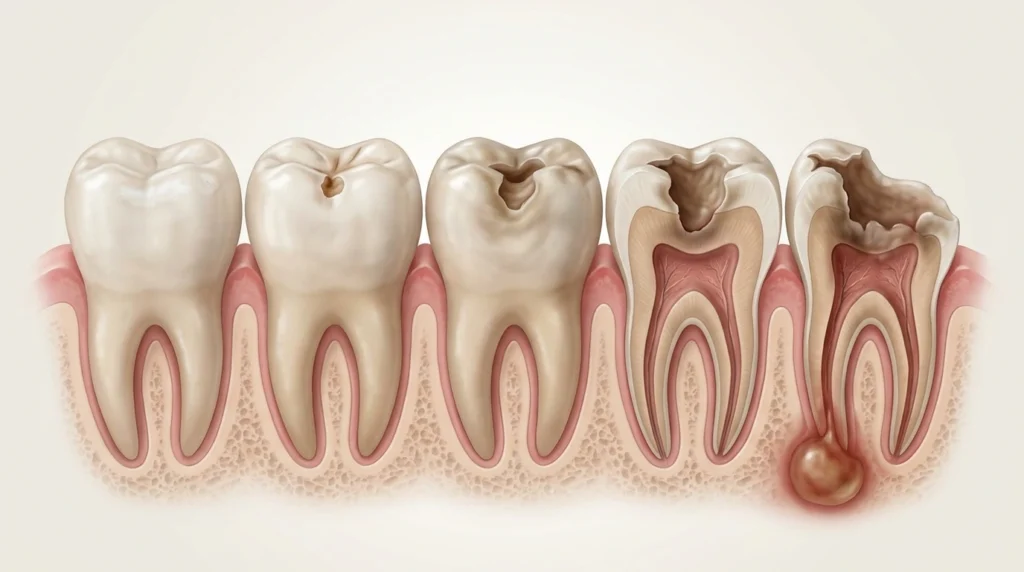
Stage | What it looks and feels like | Reversible? |
1. Early demineralization (white spot lesion) | Chalky white or cream-coloured spot, often near the gumline or around braces; surface smooth and intact; no pain | Yes. Fluoride, plaque control and fewer sugar exposures can remineralize it over 3 to 6 months |
2. Enamel cavity | White spot turns brown or grey; surface feels slightly rough or catches floss; still no pain | Partly. A very shallow enamel-only breach can sometimes be arrested and hardened, but the defect stays and is usually filled |
3. Dentine involvement | Visible hole or dark shadow; sensitivity to sweet, cold and hot; food packs into it | No. Dentine is softer and decay spreads sideways under the enamel; needs a filling |
4. Pulp (nerve) involvement | Spontaneous, throbbing pain, pain at night, lingering pain after hot or cold | No. Needs root canal treatment or extraction |
5. Abscess | Swelling, pus, bad taste, pain on biting, sometimes a gum boil or facial swelling | No. Urgent root canal or extraction; antibiotics alone do not cure it |
Only the first row is truly reversible, and the second is a judgement call that depends on how deep the breach is and how well you can keep the area clean. Everything from stage 3 onward is a repair job, not a healing one. The stages also do not take equal time. The white spot stage can last a year or more in someone with reasonable habits, which is the window; once decay reaches dentine, which is about half as hard as enamel, it can spread through a molar in months, and the transition from “a bit sensitive to cold” to “up all night in pain” can be alarmingly quick. Our stage-by-stage guide to how tooth decay actually progresses shows what is happening inside the tooth at each step.
Why a Cavity Cannot Heal Itself
Bone heals because it has living cells and a blood supply that lay down new tissue. Skin heals for the same reason. Enamel has neither. It is formed once, before the tooth erupts, by cells that then disappear for good, so there is no mechanism in the body to make more of it. Dentine, the layer beneath, is slightly different: the living cells at the edge of the pulp can lay down a thin layer of “reparative” dentine on the inside of the tooth in response to irritation, which is why a tooth sometimes becomes less sensitive after a cavity is filled. But that new dentine forms on the inside, away from the decay, and does nothing to close a hole on the outside. Bacteria living in the cavity keep producing acid, food packs into the defect and feeds them, and the softened dentine is dissolved faster than any repair can keep up. This is why the popular claim that a cavity “healed on its own” is almost always one of two things: a white spot lesion that remineralized before it ever became a hole, which is real and is the point of this article, or a cavity whose pain stopped because the nerve died, which is not healing but the opposite.
What Reversing an Early Cavity Actually Involves
Step | What to do | Why it works |
Confirm the stage | Dentist checks with a probe, drying and often an X-ray | A white spot can look like an early hole and vice versa; the treatment differs completely |
Fluoride toothpaste twice daily, spit do not rinse | 1,450 ppm fluoride toothpaste; leave the foam on the teeth | Fluoride binds into enamel and forms a more acid-resistant mineral |
Professional fluoride varnish | Fluoride varnish painted on the spot every 3 to 6 months | High concentration where it is needed; the single most effective step |
Prescription high-fluoride toothpaste or gel (adults) | 5,000 ppm toothpaste or gel where the dentist advises | For multiple lesions or high decay risk |
Cut the frequency of sugar and acid | Sweets, biscuits, sugary chai, cold drinks and juices limited to mealtimes, not sipped or snacked through the day | Each exposure starts a 20 to 30 minute acid attack; six attacks a day cannot be remineralized between |
Remove plaque from the spot daily | Brush the area specifically; floss if between teeth | Plaque holds acid against the spot; clean enamel remineralizes, dirty enamel does not |
Saliva support | Sugar-free gum after meals, water through the day, treat dry mouth | Saliva carries the calcium and phosphate that rebuild the surface |
Calcium phosphate products | Some toothpastes and creams add remineralizing minerals | Modest extra benefit on top of fluoride; not a substitute |
Review | Dentist rechecks at 3 to 6 months | Confirms the lesion has hardened, or catches it if it has broken through |
The two steps that do most of the work are fluoride and frequency. Fluoride is not a rinse-and-hope measure; it is the only agent with strong evidence for hardening early lesions, and the varnish a dentist applies directly to the spot is far more concentrated than anything in a tube. Frequency of sugar matters more than quantity: a single dessert after dinner is one acid attack that saliva can undo, while a biscuit with every cup of chai across a Pakistani working day is six or seven attacks with no recovery time between them, and no amount of brushing at night compensates. A reversed white spot may stay visible as a slightly whiter, hardened patch on the enamel; that is a scar, not a failure, and it is now more resistant to decay than the enamel around it. The habits that reverse an early lesion are the same ones that prevent the next, which we set out in our guide on how to stop tooth decay.
Signs the Window Has Closed
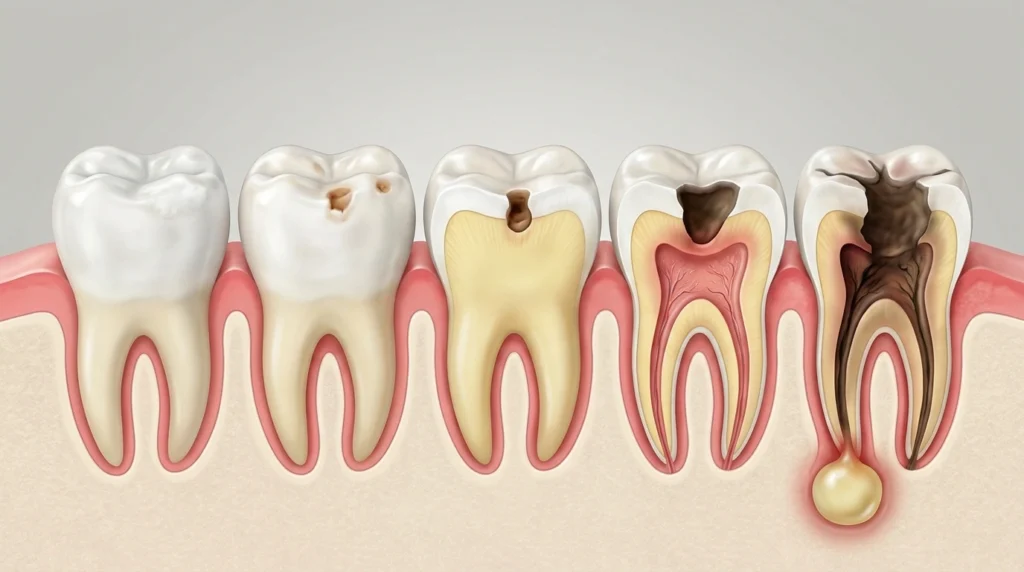
The clearest sign is a hole you can see or feel with your tongue, or a dark spot that a probe sticks into at the dentist. Others are less obvious: floss that shreds or catches at the same spot every time, food that packs between two particular teeth after meals, a sharp twinge when something sweet touches one spot, a brown line along the edge of an old filling, or a dark shadow visible through the enamel that a dentist confirms on an X-ray. Sensitivity to cold that lingers for more than a few seconds means the decay is close to the nerve, and pain that arrives on its own, wakes you at night or throbs when you lie down means it has reached it. At that point the conversation is no longer about reversal but about saving the tooth, and the honest timeline is that a filling this month costs a fraction of a root canal next year. The early cavity symptoms most people miss are covered in detail in our separate guide, and any of them is a reason to book an examination rather than to start a remedy.
What About the “Natural Cavity Healing” Claims?
Oil pulling, bone broth, vitamin K2, eggshell powder, clove oil and sugar-free diets are all promoted online as ways to heal cavities. Some are harmless and mildly useful: a diet that cuts sugar frequency helps for the reasons above, and clove oil numbs pain without treating anything. None has any evidence of closing a cavity that has broken through enamel, and some, particularly the advice to avoid fluoride, actively remove the one thing that does help. Baking soda, charcoal and lemon “detox” methods make matters worse by thinning the enamel further. The reason these claims persist is that early demineralization really does reverse, and someone who changed their diet while a white spot was hardening will honestly believe the diet did it; the same person applying the same regimen to a real cavity will watch it grow. If you have been managing a spot at home for a few months and it has not visibly hardened or has started to feel rough, catch floss or twinge, stop experimenting and have it looked at; our dentists will tell you plainly whether it can still be arrested or needs a small filling, and either way the appointment costs less than waiting.
Frequently Asked Questions
Can a cavity go away on its own?
No. Only the earliest stage of decay, a white spot with the enamel surface still intact, can reverse, and only with fluoride, plaque control and fewer sugar exposures. Once a hole has formed, it never closes and only grows. A cavity that stops hurting has usually reached and killed the nerve, not healed.
How do I know if my cavity is still reversible?
If the spot is chalky white, smooth, and there is no hole, roughness or sensitivity, it is likely reversible. If it is brown, feels rough, catches floss, holds food or reacts to sweet or cold, it has broken through and needs a filling. A dentist can tell in minutes with a probe and, if needed, an X-ray.
How long does it take to reverse an early cavity?
Usually 3 to 6 months of consistent fluoride toothpaste, professional fluoride varnish, daily plaque removal from the spot and limiting sugar to mealtimes. The dentist rechecks at 3 to 6 months to confirm the lesion has hardened. The white mark may remain as a harmless scar.
Does fluoride really reverse cavities?
At the white spot stage, yes; it is the only agent with strong evidence for hardening early enamel lesions, and a fluoride varnish applied by a dentist is the most effective form. Fluoride cannot fill a hole that has already formed; at that stage it only helps protect the surrounding enamel.
Can a cavity heal without a filling if I stop eating sugar?
Cutting sugar frequency is essential for reversing an early white spot and for slowing the spread of a real cavity, but it does not regrow lost enamel. A cavity that has broken through the surface still needs a filling; diet changes make the filling last longer and prevent the next one.
