
Quick Answer
Home whitening can genuinely lift surface stains from chai, coffee, paan and smoking by about one to two shades, using a whitening toothpaste twice daily, a baking soda paste once or twice a week, and peroxide-based whitening strips if you want more. It cannot change the natural colour of your enamel, cannot whiten crowns, fillings or veneers, and cannot fix stains that live inside the tooth from medicines, fluorosis, injury or age; those need professional whitening or a cosmetic fix. Lemon, vinegar, charcoal, salt scrubbing and undiluted hydrogen peroxide either do nothing or wear enamel away, and enamel does not grow back.
Search “daant safed karne ka tarika” and the internet hands you a kitchen: lemon juice, banana peel, strawberries, charcoal, salt, turmeric, coconut oil. Almost none of it works, some of it does real damage, and the reason is a fact the videos skip. Tooth colour comes from two layers. Enamel on the outside is slightly translucent and picks up stains from what you eat, drink and smoke; those are surface stains, and they respond to home care. Dentine underneath is naturally yellow, and it shows through more as enamel thins with age or acid; that colour is inside the tooth, and no paste, fruit or powder touches it. Home whitening is, honestly stated, stain removal. It is useful, it is cheap, and it has a ceiling.
Knowing that ceiling saves both your money and your enamel. In Pakistan the common stains are the ones home methods handle best: chai several times a day, paan and gutka, cigarettes, and the yellow film of plaque and tartar that a good cleaning removes in one visit. Most people who feel their teeth are “yellow” would see a visible improvement from removing those alone. This guide sets out what genuinely works at home and how to do it without harm, the popular methods to stop immediately, what home whitening can never achieve, and how professional whitening differs, so that you spend your effort where it produces a result.
What Actually Works at Home
Method | What it does | How to use it safely | Realistic result |
Whitening toothpaste (fluoride, mild abrasive, sometimes low peroxide) | Polishes off fresh surface stains | Twice daily, soft brush, two minutes | Keeps new stain off; up to about one shade over weeks |
Baking soda paste | Mildly abrasive, neutralizes acid, lifts surface stain | A pinch mixed with water, once or twice a week only | Small, visible lift on chai and smoke stains |
Hydrogen peroxide rinse (1.5 to 3 percent, diluted) | Bleaches the outer layer very mildly | Diluted half and half with water, swish 30 to 60 seconds, spit, no more than a few times a week | Slight; mainly freshness, minor brightening |
Whitening strips or gels (6 to 10 percent hydrogen peroxide or equivalent carbamide) | Actual bleaching of enamel and some dentine | Exactly as the box directs, usually 30 minutes daily for 1 to 2 weeks | One to two shades on natural teeth |
Brushing after chai, coffee and paan; drinking water | Removes stain before it sets | After each cup or use; wait 30 minutes after acidic food | Prevention; the cheapest whitening there is |
Two honest notes on the table. Baking soda earns its place because the evidence supports it for stain removal, not because it is “natural”; it is a mild abrasive, and mild abrasives used daily thin enamel, so keep it to twice a week and never scrub. Whitening strips are the only home method that bleaches rather than polishes, and they work on natural teeth with intact enamel; they cause temporary sensitivity in many people, which fades within days of stopping, and they should not be used on cracked teeth, exposed roots, or while cavities or gum disease are untreated, because the gel reaches the nerve through those routes.
The Popular Methods That Damage Teeth
Method | The claim | The reality |
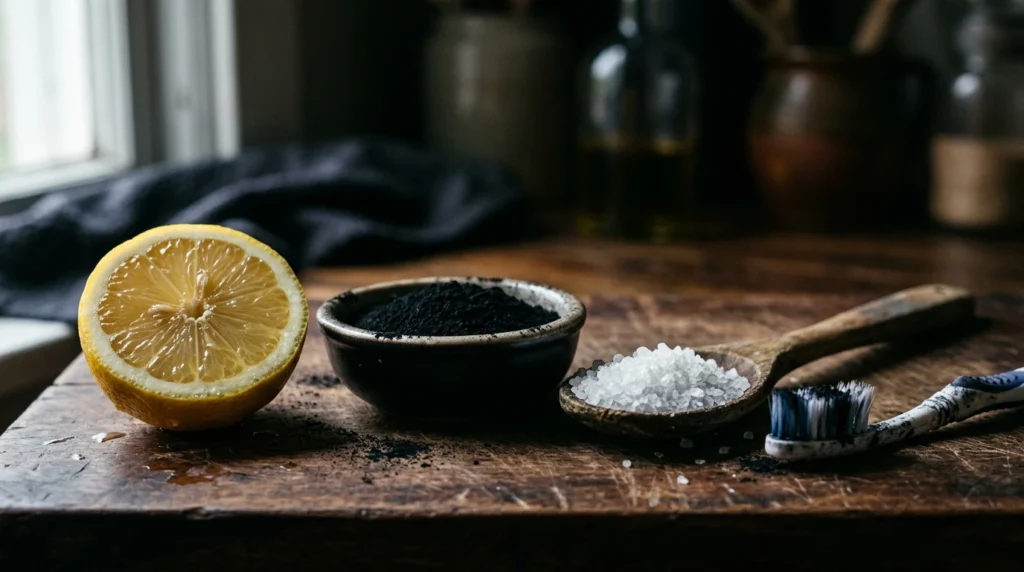
Lemon juice, vinegar, strawberry or tomato rubs | “Natural acid dissolves stains” | Acid dissolves enamel; teeth look whiter for a day as the surface is etched, then stain faster and turn sensitive |
Activated charcoal powder or paste | “Absorbs toxins and stains” | Abrasive with no proven whitening benefit; wears enamel and can lodge in gum margins and cracks |
Salt or baking soda scrubbing daily | “Scrub the yellow off” | Grinds enamel thin; the yellow dentine beneath shows more, not less |
Undiluted 3 percent or stronger hydrogen peroxide | “Stronger is faster” | Burns gums white, irritates the mouth lining, and adds nothing over diluted use |
Oil pulling with coconut oil | “Pulls out stains” | Harmless as a rinse; no evidence it whitens anything |
Turmeric paste | Folk whitener | Stains everything it touches, including teeth, temporarily yellow |
The acid methods deserve the strongest warning because they appear to work. Enamel etched by lemon juice reflects light differently for a few hours, so the mirror briefly agrees with the video. What has happened is that the outermost enamel has been dissolved; the roughened surface then collects stain faster than before, cold water begins to sting, and the loss is permanent. Anyone already feeling that sting is past whitening and into the territory we covered in our guide on sensitive teeth, where the priority becomes protecting what remains.
What Home Whitening Cannot Do
Home methods act on the outside of natural enamel, which draws four hard lines. First, intrinsic stains: grey or brown bands from tetracycline taken in childhood, white or brown patches from fluorosis, the darkening of a tooth whose nerve died after an injury, and the general yellowing of age as enamel thins; none of these live on the surface and none respond to pastes or strips. Second, dental work: crowns, veneers, bonding and fillings are made of porcelain or composite that does not bleach, so whitening around them makes the natural teeth lighter and leaves the work looking darker; whitening should happen before new front work is made, not after. Third, tartar: the yellow-brown crust at the gumline is mineralized plaque, and it is removed by professional scaling and polishing, not by any whitening product; many people who buy strips are actually looking at tartar, and one cleaning visit does what a month of strips could not. Fourth, teeth that are yellow because they are unhealthy: decay, worn enamel and receding gums all change tooth colour, and whitening an untreated problem is painful and pointless.
Professional Whitening: What Is Different
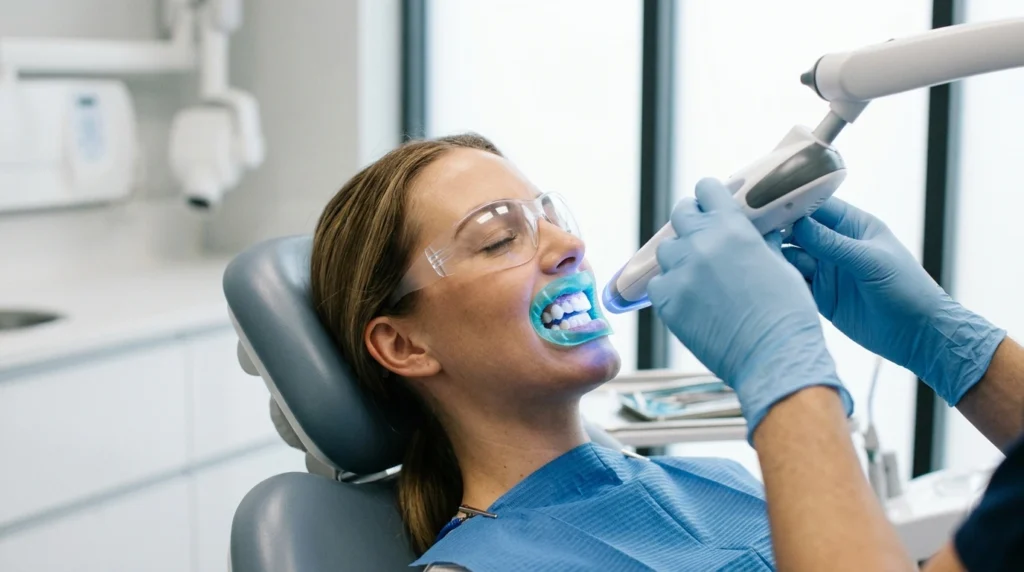
The active ingredient is the same family, hydrogen or carbamide peroxide, but the concentration, the protection and the result are not. In-clinic whitening uses a far stronger gel, applied after the gums are shielded with a protective barrier, often activated by light, and produces several shades of change in a single 60 to 90 minute visit on stains that home strips cannot move. Dentist-supervised take-home trays use a medium-strength gel in custom-fitted trays worn for a couple of weeks, which delivers a steadier, more even result than one-size strips and protects the gums from gel spill. Both are preceded by an examination, because the dentist first confirms the stain is one whitening can treat, cleans the teeth so the gel reaches enamel rather than plaque, and treats any cavity or gum problem that would otherwise turn whitening into a week of pain. For stains that even bleaching cannot shift, such as heavy tetracycline banding or a single dark tooth, the honest answer moves to veneers or a crown, which replace the visible surface rather than lightening it. If you have tried the home methods above for a month with a modest result, or if a single tooth is darker than the rest, the next sensible step is a consultation for professional teeth whitening, where the cause of the colour is identified before anything is applied; it is the only route that tells you, before you spend, whether your particular yellow is one that can be whitened at all. Our guide to yellow teeth treatment sets out those options side by side.
Frequently Asked Questions
How can I whiten my teeth at home naturally?
Brush twice daily with a fluoride whitening toothpaste, use a baking soda and water paste once or twice a week, rinse with water after chai, coffee or paan, and consider peroxide whitening strips used exactly as directed. Expect one to two shades on surface stains; deeper colour needs professional whitening.
Does baking soda really whiten teeth?
It removes surface stains modestly because it is a mild abrasive, and studies support that effect. It does not bleach the tooth or change its natural colour. Use it once or twice a week; daily scrubbing wears enamel and makes teeth look yellower over time.
Is lemon juice good for whitening teeth?
No. Lemon juice is acidic and dissolves enamel. Teeth may look briefly whiter as the surface is etched, then become rough, stain-prone and sensitive. The enamel loss is permanent. Avoid lemon, vinegar and all acidic “natural” whitening rubs.
Why are my teeth still yellow after whitening at home?
Either the colour is inside the tooth (age, medicine stains, fluorosis or a dead nerve), which home products cannot reach, or the yellow you see is tartar at the gumline, which only professional scaling removes. A dentist can tell you which in one examination.
Is teeth whitening safe for enamel?
Peroxide whitening used as directed does not damage healthy enamel; temporary sensitivity is common and fades. What damages enamel is acid (lemon, vinegar), daily abrasive scrubbing (charcoal, salt, excessive baking soda) and overusing products beyond their instructions. Whitening is not advised during pregnancy, under age 16, or with untreated cavities or gum disease.
