
Quick Answer
Akal daarh ka dard, pain from a wisdom tooth, happens because the third molars arrive between 17 and 25 into a jaw that has usually already run out of room. The tooth pushes through the gum slowly, often at an angle, and in Asian populations about 4 in 10 people have at least one wisdom tooth that is stuck, or impacted. Most of the pain comes from pericoronitis, an infection of the flap of gum that lies over a partly erupted tooth and traps food under it, which produces a sore, swollen patch at the very back of the jaw, a bad taste, and pain on biting that comes and goes for days. At home, warm salt water rinses several times a day, gently brushing or syringing under the flap, paracetamol or ibuprofen in the doses on the packet, and a cold compress on the cheek will settle most first episodes within three to five days. Swelling spreading into the face or neck, a fever, difficulty opening the mouth or swallowing, or pus needs a dentist the same day. A wisdom tooth does not need removing just because it is impacted: the UK NICE guidance is to remove it only when it is causing disease, which includes a second episode of pericoronitis, decay that cannot be filled, an abscess, a cyst, or damage to the tooth in front. Removal takes 20 to 60 minutes under local anaesthetic, discomfort lasts 3 to 7 days, and the serious complications, dry socket and nerve injury, are uncommon and largely preventable.
The wisdom tooth, akal daarh in Urdu because it arrives when a person is supposed to have grown wise, is the last tooth to come and the one most likely to cause trouble on the way. In Pakistan the trouble usually arrives in the final years of college or the first years of a job, as a dull ache at the very back of the lower jaw that flares every few weeks, is treated with a painkiller and a visit to the chemist, and is forgotten until the next flare. Two beliefs make it worse. The first is that the pain is simply the tooth “coming out” and must be endured; sometimes it is, often it is an infection that is being allowed to recur. The second is the opposite, that every wisdom tooth must be pulled before it causes harm; that was the practice in many countries until the evidence was reviewed, and it is no longer recommended.
This guide explains what is actually happening when a wisdom tooth hurts, how to tell ordinary eruption discomfort from pericoronitis and from the more serious problems, what genuinely helps at home and what does not, the warning signs that mean the same-day dentist, the honest rules for when a wisdom tooth should be removed and when it should be left, what removal involves and how recovery goes, and the complications you should know about before agreeing to surgery. For the general causes of tooth pain anywhere in the mouth, our guide to dant me dard kyun hota hai covers the wider picture.
Why Wisdom Teeth Hurt
| Cause | What is happening | How it feels | Clue that this is yours |
| Normal eruption | The tooth is cutting through the gum; the gum stretches and is tender | Dull ache or pressure at the back of the jaw for a few days at a time, over months | Pain mild, no swelling, no bad taste, settles on its own |
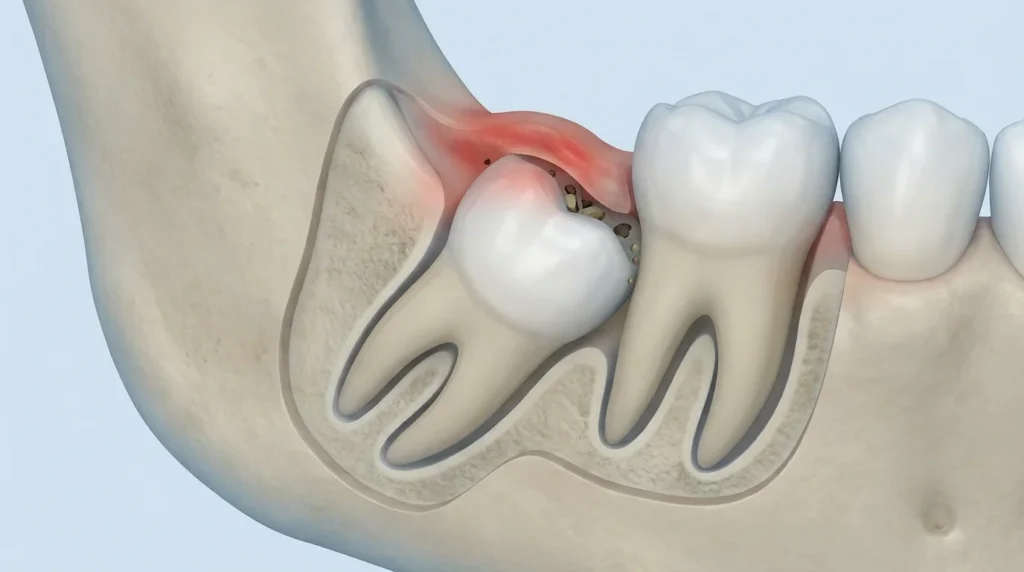
| Pericoronitis | A flap of gum (operculum) over a partly erupted tooth traps food and bacteria and becomes infected | Sore, swollen, red gum behind the last molar; pain on biting as the upper tooth presses the flap; bad taste or smell; sometimes pain radiating to the ear | The commonest cause of real wisdom tooth pain; worse after meals; may come with a slight fever |
| Impaction | The tooth is wedged against the tooth in front or the jaw bone and cannot come through, often tilted forward or lying flat | Deep pressure, aching in the jaw, sometimes headache or ear ache; pain in the tooth in front | Seen only on an X-ray; about 24 to 37% of adults have at least one, higher in Asia |
| Decay in the wisdom tooth or the tooth in front | A tooth that is hard to clean decays; a tilted wisdom tooth packs food against the back of the second molar | Sharp pain with sweets, cold or hot; a hole or dark spot | Our guide to cavity symptoms describes the signs |
| Abscess | Infection has spread from the gum flap or the tooth into the bone | Constant throbbing, swelling of the cheek or jaw, fever, feeling unwell | Needs a dentist the same day; see our guide to medicine for tooth infection |
| Cyst around the crown | A fluid-filled sac grows from the follicle of an unerupted tooth | Often painless until large; slow swelling of the jaw | Found on X-ray; a clear reason for removal |
| Gum disease behind the second molar | The wisdom tooth makes the area impossible to clean, and a deep pocket forms on the back of the tooth in front | Bleeding, soreness, loosening of the second molar over years | A reason to remove the wisdom tooth to save its neighbour |
Pericoronitis deserves the most attention because it is what most people mean by akal daarh ka dard, and because its pattern, flaring for three to five days and then easing, teaches people to wait it out. Each episode leaves the flap a little more scarred and the pocket under it a little deeper, and the NICE guidance that governs wisdom tooth surgery in the UK draws its line exactly here: one episode, unless severe, is treated and watched; a second or subsequent episode is an accepted reason to remove the tooth.
Akal Daarh Ka Dard Ka Ilaj at Home
| Measure | What it does | Honest verdict |
| Warm salt water rinse (half a teaspoon of salt in a glass of warm water), held over the back of the mouth for 30 seconds, 4 to 6 times a day, especially after eating | Flushes food from under the gum flap and soothes the inflamed gum | The single most useful home step for pericoronitis |
| Gently brushing the area with a soft brush, or flushing under the flap with a small syringe of warm salt water or chlorhexidine mouthwash | Removes the trapped debris that is feeding the infection | Effective but uncomfortable; be gentle and persistent |
| Chlorhexidine mouthwash twice daily for up to a week | Reduces bacteria around the flap | Useful short term; stains teeth if used for more than two weeks |
| Paracetamol 500 mg to 1 g up to four times a day, maximum 4 g in 24 hours for a healthy adult | Pain relief | Safe for most people; does not reduce swelling |
| Ibuprofen 400 mg up to three times a day with food, maximum 1,200 mg in 24 hours without medical advice | Pain relief plus reduced inflammation and swelling | The better choice for wisdom tooth pain if you have no stomach ulcer, kidney problem or asthma that reacts to it; alternating paracetamol and ibuprofen is common practice |
| Cold compress on the cheek, 10 to 15 minutes on and off | Numbs and reduces swelling | Helpful in the first two days of a flare |
| Soft food, chewing on the other side, plenty of water | Rests the flap and reduces food packing | Sensible |
| Clove oil (laung ka tel) dabbed on the gum | Mild numbing from eugenol | Brief relief only; undiluted oil burns the gum; never swallow it |
| Aspirin placed on the gum | Nothing useful | Causes a chemical burn of the gum; a very common Pakistani mistake; swallow painkillers, do not place them |
| Antibiotics from the chemist without a dentist seeing the tooth | May dampen a flare temporarily | Does not remove the cause; the flare returns; resistance grows. Antibiotics are for spreading infection or fever, decided by a dentist |
| Hot compress on the face | Draws infection outward | Can worsen a spreading infection; use cold on the face, warm only inside the mouth |
| Totkay such as rubbing tobacco, naswar or garlic on the gum | Nothing | Irritates the gum and worsens infection |
Give a first episode three to five days of this routine. If the pain is easing by day three, finish the week and then ask a dentist to look at the tooth at your convenience, because the X-ray will show whether it has room to come through or not. If the pain is not easing, or any of the signs in the next section appears, do not wait out the week. Pain that is worse at night is common with any tooth infection; our guide to toothache at night explains why and what helps.
When to See a Dentist the Same Day
Wisdom tooth infections sit close to the spaces of the neck, and in a minority of cases they spread fast. These are the signs that the problem has moved beyond a sore gum flap and needs a dentist, or an emergency department, the same day: swelling that is spreading into the cheek, under the jaw or down the neck; difficulty opening the mouth more than two finger widths, called trismus; difficulty or pain on swallowing; any difficulty breathing, which is an emergency; fever or feeling generally unwell; pus from the gum or a foul taste that does not clear with rinsing; pain not controlled by regular paracetamol and ibuprofen; and swelling of the floor of the mouth that pushes the tongue up. If a dentist cannot be reached, the emergency department of a teaching hospital is the right place, and the treatment will be antibiotics, drainage if there is an abscess, and removal of the tooth once the acute infection has settled. You can book an appointment with our oral surgery team and tell reception it is a wisdom tooth with swelling; those are seen the same day.
Akal Daarh Kab Nikalwani Chahiye: When Removal Is Right and When It Is Not
The old practice, still common in Pakistan, was to remove every impacted wisdom tooth in a young adult on the grounds that it would cause trouble eventually. In 2000 the UK’s National Institute for Health and Care Excellence reviewed the evidence and concluded that the routine removal of impacted wisdom teeth that are free of disease should stop, because the surgery carries real risks and most such teeth never cause a problem. That guidance, NICE TA1, remains in force and under review, and NICE has since restated that there is still no reliable evidence that removing healthy impacted wisdom teeth is beneficial. The indications for removal are specific.
| Situation | Remove? | Reason |
| Impacted, no symptoms, no disease on X-ray | No; monitor at routine check-ups | Surgery risk outweighs benefit; most never cause trouble |
| First episode of pericoronitis, mild to moderate | No; treat the infection and clean the flap | Many first episodes never recur, especially if the tooth is still erupting |
| First episode that is severe, with facial swelling or spread | Yes, once the infection has settled | Severe spread is itself an indication |
| Second or subsequent episode of pericoronitis | Yes | NICE names recurrent pericoronitis as an appropriate indication |
| Decay in the wisdom tooth that cannot be filled because of its position | Yes | Unrestorable caries |
| Decay or gum pocket on the back of the second molar caused by the wisdom tooth | Yes | Protects a far more valuable tooth |
| Abscess, cellulitis or bone infection from the tooth | Yes | Pulpal or periapical disease and infection |
| Cyst or tumour around the crown on X-ray | Yes | Disease of the follicle |
| Resorption of the root of the tooth in front | Yes | The wisdom tooth is destroying its neighbour |
| Fractured wisdom tooth | Yes | Fracture is an indication |
| Tooth in the way of planned jaw surgery or orthodontics | Yes, as part of that plan | Impeding surgery |
| Plaque trapping alone, with no infection | No | NICE states plaque alone is not an indication |
| Upper wisdom tooth biting into the lower gum flap | Often yes; upper teeth are simple to remove | Removing the upper tooth can resolve lower pericoronitis without lower surgery |
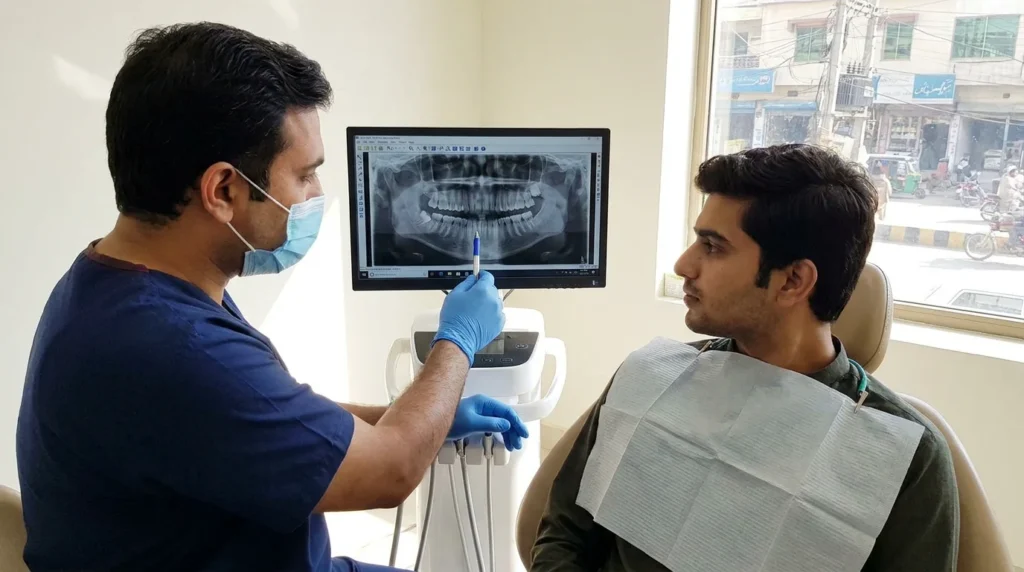
A good oral surgeon will show you the X-ray, point to the reason, and tell you which category your tooth falls into. If the answer is “it might cause trouble one day,” the honest advice is to keep it and keep it clean. Our wisdom teeth treatment page sets out how we assess them.
Akal Daarh Nikalwane Ka Tarika: What Removal Involves
An upper wisdom tooth is usually a simple extraction under local anaesthetic that takes a few minutes. A lower wisdom tooth, particularly one lying at an angle, is a minor surgical procedure: after the local anaesthetic has taken full effect, the surgeon makes a small cut in the gum, removes a little bone around the crown if needed, often divides the tooth into two or three pieces so that each can be lifted out without force, washes the socket and closes the gum with a few dissolving stitches. The whole visit takes 20 to 60 minutes and you feel pressure and vibration but not pain. Sedation or a general anaesthetic is reserved for very anxious patients, several difficult teeth at once, or teeth close to the nerve, and is done in a hospital setting. Before the procedure, tell the surgeon about every medicine you take, including aspirin, blood thinners, diabetes medicine and the contraceptive pill, and whether you smoke, because each changes the plan or the aftercare.
| Timeline after removal | What to expect | What to do |
| First 24 hours | Numbness for 2 to 4 hours; oozing of blood-stained saliva; the start of swelling | Bite on the gauze for 30 to 45 minutes; cold compress 15 minutes on and off; no rinsing, spitting, straws, smoking, hot drinks, alcohol or exercise; soft cool food; take the painkillers before the anaesthetic wears off |
| Days 2 to 3 | Swelling peaks at 48 to 72 hours; bruising of the cheek in some; stiffness of the jaw | Start gentle warm salt water rinses after 24 hours, letting the water fall out rather than spitting; soft food; keep taking painkillers regularly |
| Days 3 to 7 | Pain and swelling easing each day; stitches begin to dissolve; about 1 in 100 develops an infection in this window | If pain gets worse rather than better from day 3, especially with a bad taste, suspect dry socket and call the clinic |
| Week 2 | Swelling gone; gum closing over; eating normally | Keep the area clean; the socket is still a hollow that traps food, so rinse after meals |
| 4 to 6 weeks | Gum fully healed; bone filling in beneath | Nothing special |
| 3 to 6 months | Bone fully remodelled | The space is no longer noticeable |
Our guides to tooth extraction healing time and what to eat after a tooth extraction give the full aftercare and food lists, which apply to wisdom teeth with the additions above.
The Complications Worth Knowing About
Dry socket, or alveolar osteitis, is the commonest complication of lower wisdom tooth removal. The blood clot that should fill the socket is lost or dissolves, exposing bare bone, and the result is a deep, throbbing pain that begins three to five days after the extraction, often spreading to the ear, with a bad taste and an empty-looking socket. In a large series of more than 3,000 lower wisdom tooth removals the overall rate was about 2.6%, higher in women than men, and far higher, around 15%, in women taking the contraceptive pill; smoking roughly triples the risk, with studies showing around 12 to 13% in smokers against 4% in non-smokers. It is not an infection and antibiotics do not treat it; the dentist washes the socket and places a soothing dressing, which relieves the pain within hours, and it heals within one to two weeks. Prevention is in the first 72 hours: no smoking, no spitting or straws, no vigorous rinsing, and women on the pill may be advised to schedule surgery in the days of their cycle when hormone levels are lowest.
Nerve injury is the complication patients fear most and it is uncommon. The lower wisdom tooth roots sit close to the inferior alveolar nerve, which supplies feeling to the lower lip and chin, and the lingual nerve, which supplies the side of the tongue, lies in the gum on the inner side. In a large published series, any nerve injury occurred in about 0.7% of removals, and permanent injury in about 0.2% for the lip nerve and under 0.1% for the tongue nerve; most injuries recover within four months. The risk is higher after 25, with horizontal or forward-tilted impactions, under general anaesthetic, and with less experienced operators, which is why a lower wisdom tooth that sits on the nerve on the X-ray should be removed by an oral surgeon, sometimes with a 3D scan first, and sometimes deliberately left in place. Infection after removal affects about 1 in 100 and appears between day three and day seven; it is treated with antibiotics and cleaning. Bleeding that soaks through gauze after an hour of firm biting, or restarts heavily after the first day, needs a call to the clinic. Set against these numbers, the risks of leaving a repeatedly infected or decayed wisdom tooth, recurrent abscesses, loss of the second molar and the occasional spreading neck infection, are the reason removal is right when the indication is there, and the reason it is wrong when it is not.
Frequently Asked Questions
Akal daarh ka dard kyun hota hai?
Because wisdom teeth come through between 17 and 25 into a jaw that usually has no room, so they erupt slowly, at an angle, or get stuck. Most pain is pericoronitis, infection of the gum flap over a partly erupted tooth that traps food. Decay, an abscess or pressure on the tooth in front are the other causes.
Akal daarh ke dard ka fori ilaj kya hai?
Warm salt water rinses four to six times a day, gently cleaning under the gum flap, ibuprofen 400 mg with food up to three times a day (or paracetamol if you cannot take ibuprofen), a cold compress on the cheek, soft food and chewing on the other side. Never place aspirin or tobacco on the gum. If it is not easing by day three, see a dentist.
Kya har akal daarh nikalwani zaroori hai?
No. A wisdom tooth that is impacted but causing no disease should be monitored, not removed; NICE guidance says routine removal of healthy wisdom teeth should stop. Removal is right for repeated pericoronitis, decay that cannot be filled, an abscess, a cyst, or damage to the tooth in front.
Akal daarh nikalwane ke baad kitne din dard rehta hai?
Three to seven days of discomfort, with swelling worst at 48 to 72 hours and gone within two weeks. Pain that gets worse after day three with a bad taste suggests dry socket, which the dentist treats with a dressing. The gum heals in about four to six weeks.
Kya akal daarh nikalwana khatarnak hai?
For most people, no. Dry socket affects about 2 to 3% of lower wisdom tooth removals, more in smokers and women on the pill, and is painful but treatable. Nerve injury affecting the lip or tongue occurs in under 1% and is usually temporary; permanent injury is around 0.2% or less. Choosing an experienced oral surgeon and following the aftercare rules keeps both risks low.
